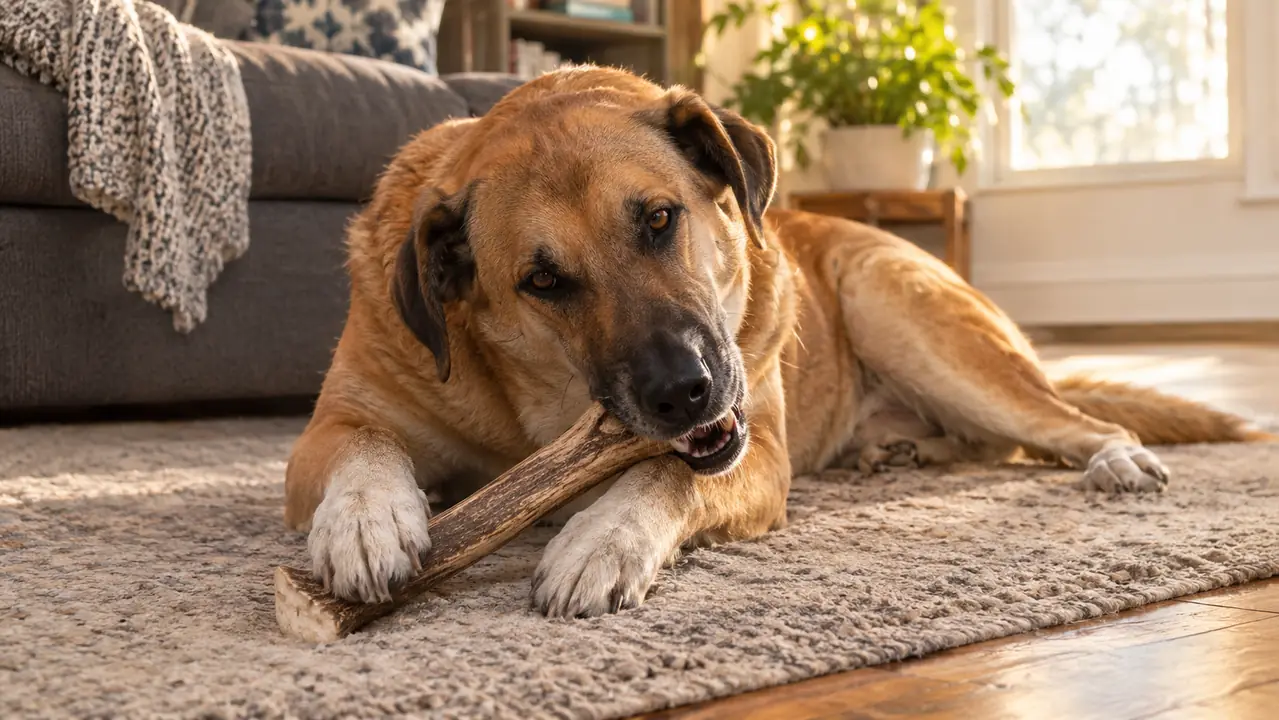
Eight months ago I set a piece of elk antler on the rug in front of Tucker, and he looked at me like I had handed him a rock. Near enough, I had. He sniffed it, licked it once, walked to the back door and asked to go out. The first honest thing I can tell you about the Elkhorn Premium Chews X-Large Whole antler is that it did not win him over in an afternoon. It took about three days, and a little patience on my end, before he decided it was worth his time. If you are expecting the reception a bully stick gets, this is not that.
I bought it for a specific reason. Tucker is seven, a yellow Lab mix, about 68 pounds, and he is a serious chewer with a stomach that has opinions. Bully sticks are in the rotation and always will be, but one lasts him 45 minutes to an hour and then it is gone. Yak cheese lasts longer and goes camping with us. What I wanted was something that sat in the toy basket for months and gave him real work to do in the garage on a Saturday, and antler was the thing I had not tried. I went with the whole X-Large, 7 to 10 inches long, because split antlers disappear too fast in a mouth this size. The listing puts it at 50 to 90 pounds, which fits him with room on either side.
Before I settled on this one I spent two evenings reading about split versus whole, which is two evenings I will not get back. The appeal of a split antler is obvious. The marrow is already exposed, so the dog does not have to work for it, and the first hour is a success. The catch is that the same exposed middle is what vanishes first, and a 68 pound dog with a heavy jaw can hollow a split piece out in a couple of sessions and then you own a thin shell with edges on it. The whole piece from Elkhorn Premium Chews makes the dog earn the marrow through a small opening at one end, and that single difference is why this chew is still in my house going into a second season. The first hour is duller. Every hour after it is the reason I bought the thing.
The Quick Verdict
A long haul chew that earns its spot in the basket, provided you go in knowing your dog may ignore it for a few days and that the weekly safety check is your job, not the dog's.
Amazon Check Today's Price →Tucker ignored it for three days. Eight months later it is still in the basket.
Elkhorn Premium Chews X-Large Whole, 7 to 10 inches long, sized for 50 to 90 pound dogs. One piece per bag, hand cut and smoothed before it ships.
Amazon Check Today's Price on Amazon →What Nobody Tells You Before the First Chew
Antler is bone, not a baked dough or a pressed rawhide, and it behaves like bone. That sounds obvious until you own one. It does not soften at the edges the way a yak cheese does, it does not get greasy, and it has almost no smell of its own, which mattered to me after a long stretch of bully sticks that made the living room smell like a barn. What it does instead is give, slowly, in a fine powder that settles into the rug under wherever Tucker happens to be lying. I vacuum more than I used to. That is the trade, and it is worth saying out loud before you buy rather than after.
The second thing is that these are cut from a real antler, so they vary. The listing says so plainly, size and shape will vary, and I am glad it does, because the one in the photo is not the one in the bag. Mine came in just under nine inches long and about an inch and three quarters across, a bit over nine ounces. That sits inside the stated range of 7 to 10 inches long and 1.25 to 2 inches in diameter, and it lines up with the 50 to 90 pound sizing, which is where a 68 pound dog lands comfortably. If you need the exact object you saw on screen, buy something molded instead.
The third thing is the one I most want a stranger to say to me: antler is hard, and hardness is the whole conversation. My vet's general position on hard chews covers nylon, hooves and antler alike. Know your dog, watch how he works, do not leave him alone with it. Tucker is a gnawer. He picks a corner and worries at it for twenty minutes at a stretch. If your dog is a crusher, the kind that takes a run at a chew and tries to break it in half, an antler is not what I would hand him, and no amount of enthusiasm in the review section should talk you out of that.
The fourth thing is about that first week, and it is the part I would have gotten wrong on my own. My instinct was to leave the antler on the rug and let him come around to it. That produced three days of nothing and one very suspicious dog. What worked was picking it up and putting it away, then handing it to him again at the same time I settled into the garage with a cup of coffee. Two or three repetitions of that and the piece stopped being an object that appeared on the floor and became part of the garage routine. Darlene thinks I overthink it. She is probably right. But if you hand this to a dog once, watch him walk off and conclude you wasted your money, try the routine before you write it off.
How I've Used It: Eight Months in the Basket
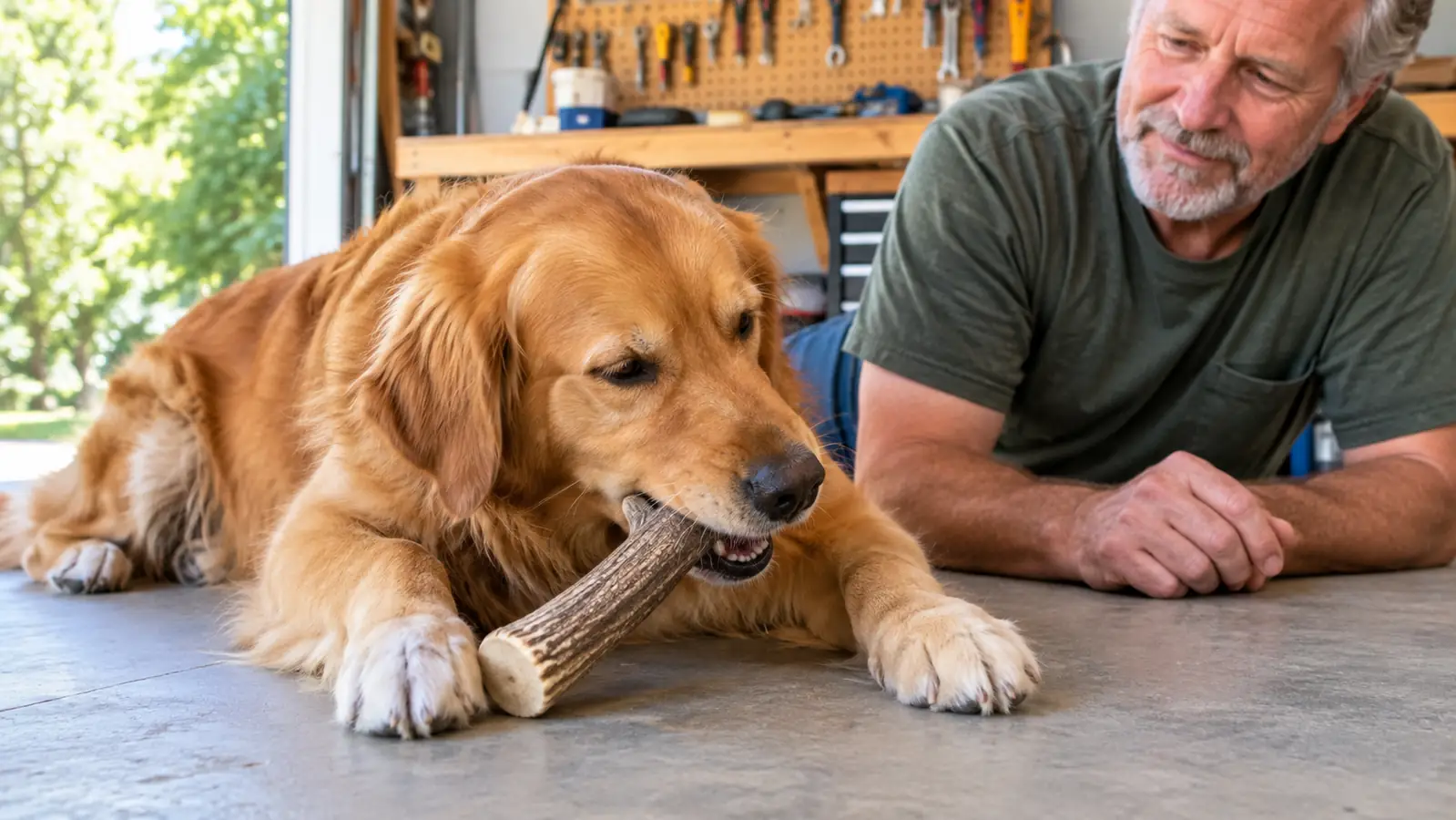
The antler lives in the toy basket by the back door. That placement is deliberate. It is not a treat that comes out at suppertime, it is a piece of equipment, and it comes out when I am in the garage or working in the yard and Tucker is out there with me. Call it twice a week. He works at it for twenty minutes, wanders off to sniff something important, comes back, works at it again. On a long Saturday in the garage he might put in an hour total across three or four visits, and then he sleeps like a dog who did a day of labor.
One Saturday in April sticks with me because it is the closest thing to a clean test I have. It rained all morning, so there was no walk and no yard work, and Tucker was doing laps around the kitchen by nine o'clock, which is his way of saying the day has gone wrong. I put the antler down on the garage floor at maybe a quarter past nine. He was on it before I got the coffee going. He worked one end, dropped it, went and stood at the door and listened to the rain, came back, worked the same end again. At half past ten he was flat on the concrete with his chin on his paws and the antler between them. He was not asleep. He was done. That hour and change of quiet is what I paid for, and I got a lot of them this year.
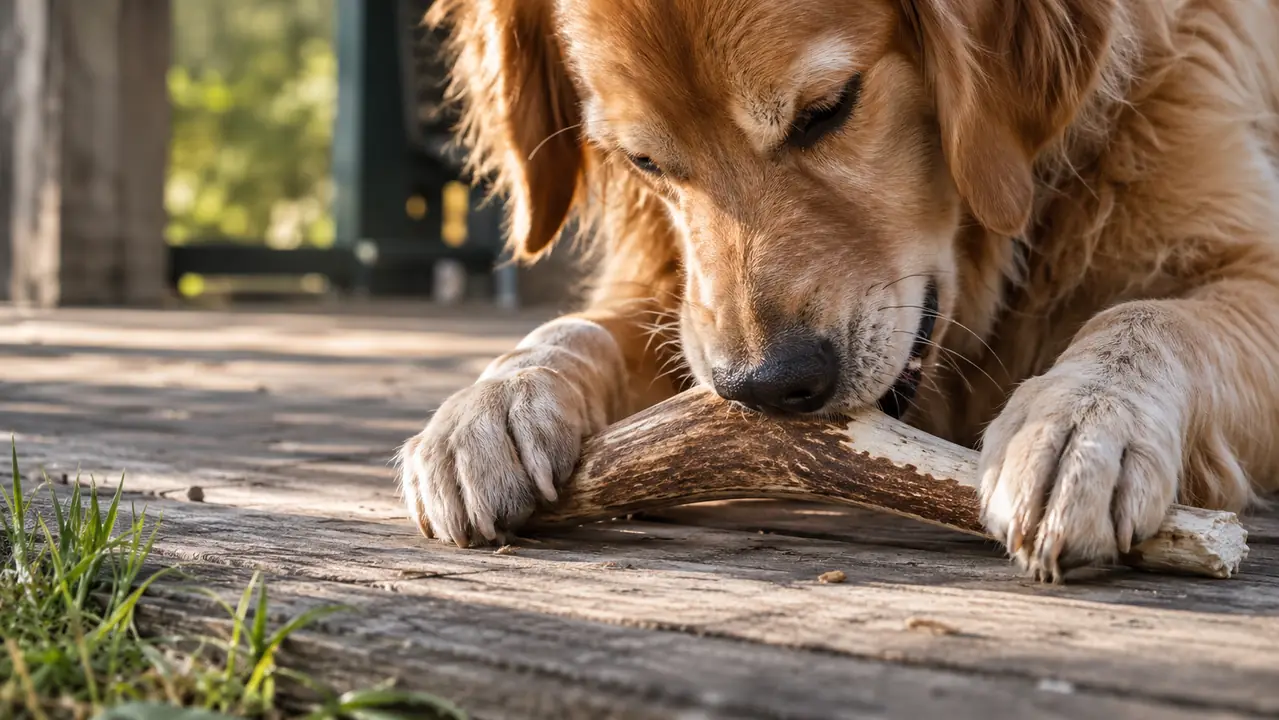
Eight months in, there is visible wear. The end he favors is rounded over, and the tip has given up somewhere around a quarter inch. The whole piece has lost a little weight, though it still feels substantial when I pick it up. Put that next to the bully sticks, gone in under an hour, or the yak cheese, which he works through over several days, and you can see the trade. The antler is not the most exciting thing in the basket. It is the one that is still there eight months later, which is its own kind of argument.
Every Sunday I pick it up and run my thumb around both ends, looking for a thin edge. The listing says each piece is hand cut and then smoothed to remove sharp edges, and mine arrived that way. Dog teeth can undo that over time. Twice now I have taken a nail file to a spot where the rim had gone thin. That is not a knock on the product. It is what happens when bone wears unevenly, and it is the cost of owning any hard chew. Ten seconds a week, is all it is. But it is your ten seconds, not the dog's.
The flavor is listed as marrow and I believe it, because his interest changed once he got past the outer shell at one end. Those first three days of indifference were a dog deciding the outside was not food. Once he broke through into the softer middle, he was committed. Now he knows exactly which end is the good end, and he goes back to it every single time he gets the piece.
What I Liked
- Lasts months in a serious chewer's mouth instead of minutes
- Almost no odor, so it can live indoors in the toy basket
- One whole unsplit piece, which is what a 68 pound dog actually needs
- Hand cut with the sharp edges smoothed before it ships
- Single special ingredient, elk antler, and gluten free
- Gives a bored dog real work on a Saturday afternoon
Where It Falls Short
- Your dog may ignore it for the first few days
- It is hard, and wrong for a dog that tries to break chews apart
- Nine inches of bone makes a genuine racket when it hits the floor
- Leaves a fine dust where the dog chews
- Needs a weekly thumb check for sharp edges
- One piece is the entire order, so there is no spare in the bag
The antler is not the most exciting thing in the basket. It is the one that is still there eight months later.
The Parts I Do Not Love
It weighs a bit over nine ounces and it is dense. When Tucker drops it on the porch it sounds like someone hit a fence post with a hammer. On a wood floor inside it is worse, so the rule here is that it stays outside or on the rug in the living room where Darlene can keep an eye on the floor. If you have hardwood and a dog that carries things from room to room, that is a real consideration and not a small one.
Nine inches is also a lot of chew. In a 68 pound dog's mouth it works, but it is not a lap chew and it does not tuck neatly into a corner. It rolls under the couch. It catches on chair legs. I have stepped on it in the dark in the garage more than once, and while I would rather step on it than on a soft training treat, it still gets your attention.
The carrying is its own small comedy. Tucker likes to move a chew to a better spot, and this one is long enough that his grip is off center, so he walks with the heavy end swinging. Twice he has clipped a door frame on the way through. Once he dropped it on the edge of the porch step and it went off the side into the shrub bed, and I had to go get it in my good shoes. None of that is the product's fault and I am not pretending it is a defect. I am telling you that a nine inch piece of bone in a dog's mouth becomes part of the furniture of your day, and if a chew that stays put matters to you, a shorter size would be the smarter buy.
And it is not a treat in the way most people use that word. There is no finishing it. There is no greeting at the door moment. If you want something to hand over when company arrives or when the mail truck comes up the drive, this is the wrong tool, and the soft training treats in the pouch on my belt do that job far better. The antler is for when the dog needs something to do and you need an hour of quiet.
What the Brand Gets Right, and What It Does Not Promise
Elkhorn Premium Chews sells this as one whole X-Large piece in a bag rather than a multipack, which threw me at first because I am used to buying chews by the three count. The single piece is the point. You are buying a chew that is meant to outlast the dog's interest, sit in the basket, and come back when the interest returns. The listing calls it a healthy alternative to processed chews, and for once that is not a stretch. The special ingredient is elk antler. That is the whole list. It is gluten free, which I notice because Tucker's stomach notices everything, and nothing about this chew has upset him in eight months.
What the brand does not promise is that your dog will like it, that it will not wear sharp, or that it will last a specific number of months. Those are things you find out on your own kitchen floor. Mine has been in service for roughly eight months. At the current rate I would guess there is another year in it, maybe more, and I will keep checking both ends every Sunday until it stops being worth the risk. That is the deal with any hard chew, and the sooner an owner accepts it, the better the whole thing goes.
Who This Is For
This is for the owner of a large dog, in that 50 to 90 pound window the listing names, who already knows the dog can handle a hard chew without going at it like a wood chipper. It suits a dog that likes to lie down and work, the way Tucker does out in the garage. It suits a household where chews live in a basket by the door and come out on the weekend. And it suits someone willing to spend ten seconds a week checking both ends and filing a thin spot if it needs it. If that is you, this piece will sit in the rotation longer than anything else you buy for the jar.
It also suits the owner who is tired of buying the same thing every few weeks. When I add up what a year of short-lived chews looks like against one piece that is still here, the arithmetic stops being interesting and starts being obvious. That is the case I would make to anyone on the fence. Not that it is a better chew in the moment, because it usually is not, but that it is the only chew in my house that has never needed replacing. Tucker would tell you the bully stick is more fun. He would also tell you the bully stick is gone.
Who Should Skip It
Skip it if your dog cracks things open. Skip it if you have a puppy, because this is a chew for a grown dog with grown teeth and there is no sensible version of it for a young mouth. Skip it if what you want is a food reward or a quick distraction rather than a project. Skip it if the dog is small, since the sizing here is written for large breeds and a 20 pound dog can do nothing useful with nine inches of antler. And skip it if you are not going to inspect it. A hard chew nobody looks at is a hard chew that eventually goes in the trash, usually after the dog has already lost interest anyway.
One piece. Eight months. Still in the basket by the door.
If you have a big dog that works a chew instead of attacking it, the whole X-Large is worth a look. Check both ends weekly, let the dog set the pace, and give it a couple of days before you decide he hates it.
Amazon Check Today's Price on Amazon →