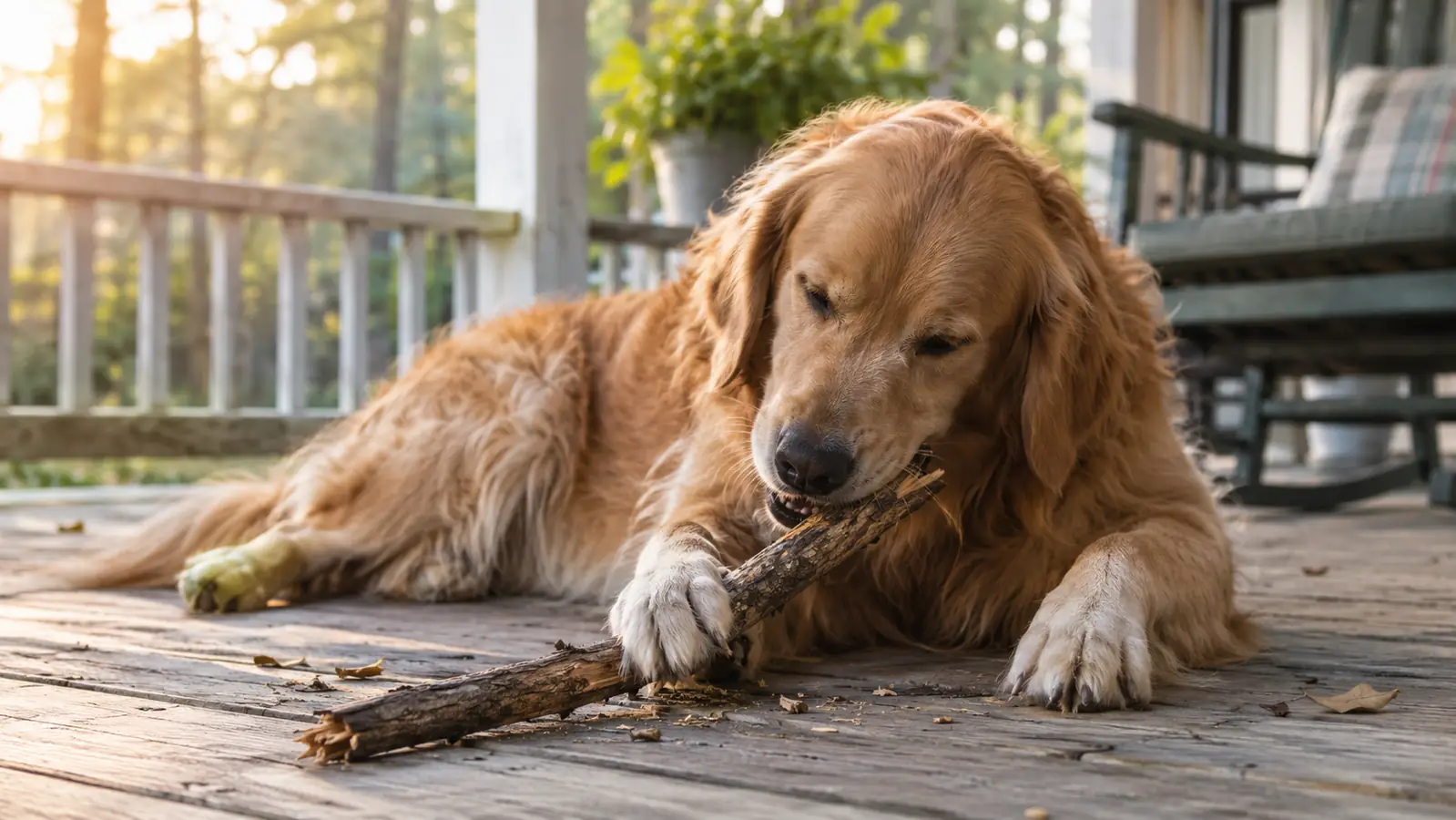
Tucker is seven years old, a yellow Lab mix at about sixty-eight pounds, and he does not chew so much as commit. Give him a soft chew and it is gone before I sit down. Give him a hard one and he works at it with his whole body, front paws braced, ears back, growling at it a little. I went through three brands that either vanished in ten minutes or left a smell in the living room that Darlene could identify from the kitchen. About fourteen months ago I bought a bag of Natural Farm Odor-Free Bully Sticks, the 12 inch, 5 count bag, and I have not bought another brand of bully stick since.
I am not an easy sell on chews. I read the back of every bag, I care where the beef came from, and I have cleaned up after enough upset stomachs to be suspicious of anything with a long ingredient list. What I want out of a chew is boring: one ingredient I can pronounce, a stick that lasts long enough to be worth handing over, and no odor war in my house. Fourteen months and something like nine repeat orders of the Natural bag have told me a lot about all three.
The Quick Verdict
One beef ingredient, a 12 inch stick that keeps a 68 pound heavy chewer busy for the better part of an hour, and the least offensive smell of any bully stick I have bought. Not cheap, and not for dogs who swallow before they chew.
Amazon Check Today's Price →The bag I keep reordering: 12 inch, 5 count, one ingredient
I have bought this same bag for fourteen months. If your dog is a serious chewer and you are tired of ten minute chews, this is where I would start.
Amazon Check Today's Price on Amazon →How I've Used It
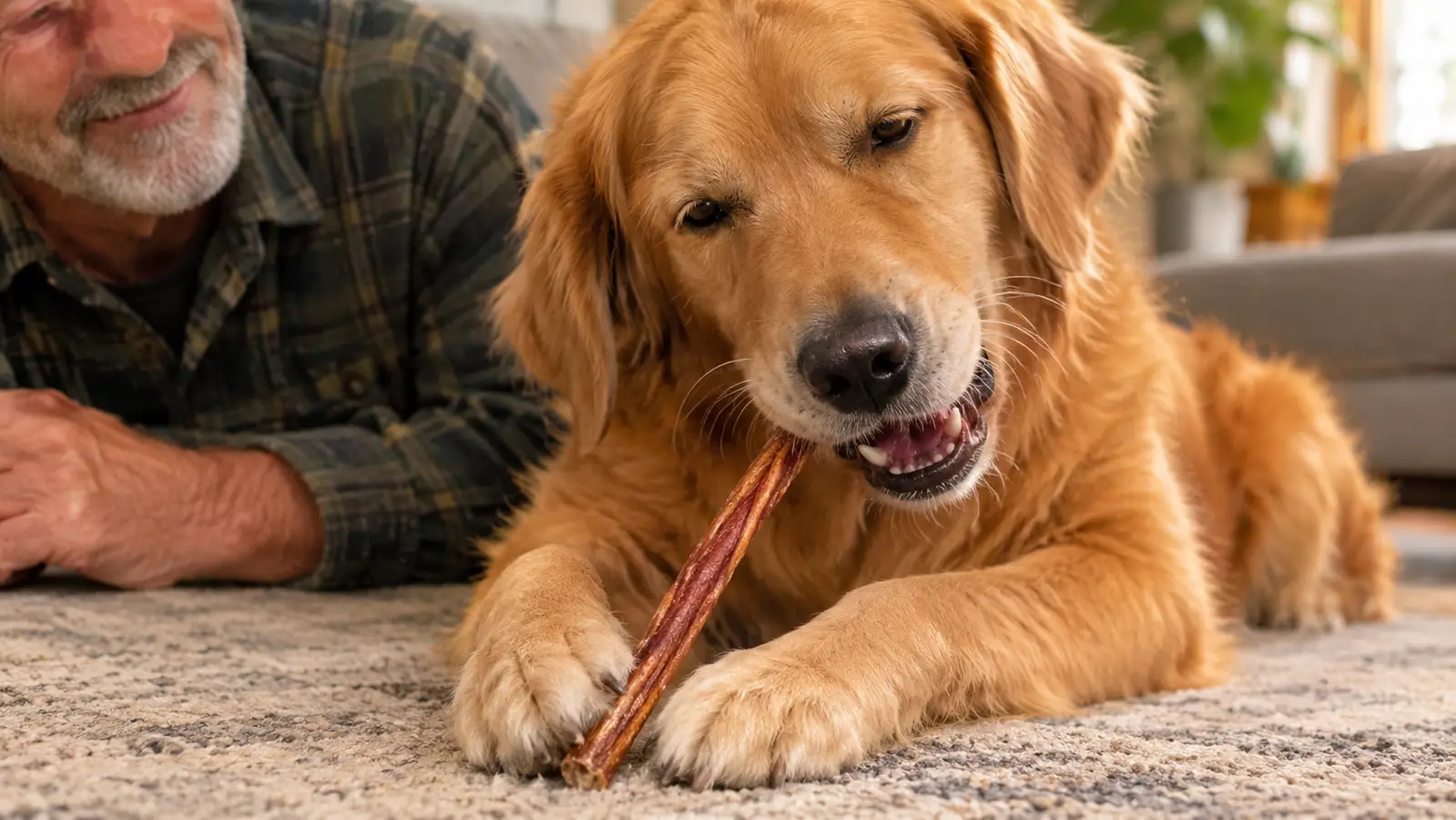
The routine has not changed since the first bag. Tucker gets one two or three times a week, never more, partly because a five count bag has to last and partly because I want him to stay interested. He gets it on the back porch when the weather is decent and on the rug in the living room when it is not. I stay in the room the whole time. That is not a knock on the stick, that is just how I handle any chew with a dog this size.
The first stick I ever handed him, back in the spring of last year, I watched like a hawk for the full fifty minutes and wrote the number down in the back of a notebook. That is a habit left over from thirty years of logging tank pressures, and it is the only reason I can give you a real figure today instead of a guess. Fifty-one minutes that first time. It has not moved much since.
When a stick gets down to about two inches I take it away and throw it out. That last piece is the part that worries me with any chew, and I would rather lose two inches than spend an evening at the clinic. Two inches on this stick is roughly the length of my thumb from the knuckle, and I have measured it more than once out of curiosity. That is my line and it does not move. At two or three sessions a week, a bag of five lasts me about a month. Rainy stretches make it shorter, because a bored dog asks for a chew about every twenty minutes.
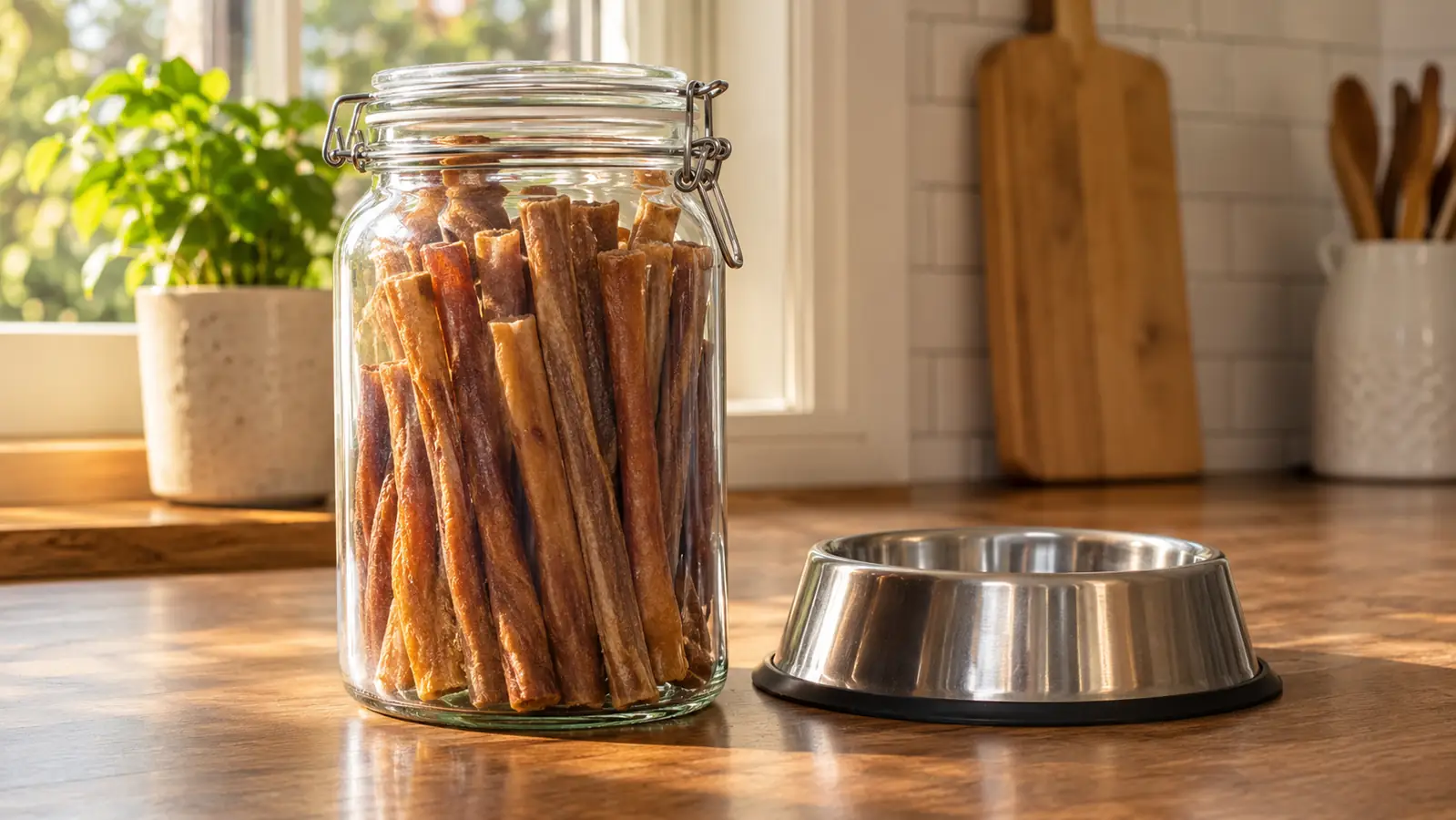
Storage is a sealed jar on the kitchen counter, the same jar the rest of his treats live in. The sticks do not go soft in there and the bag itself reseals well enough that I have never had one turn on me. Across fourteen months and a lot of repeat orders I have had exactly one bag where the sticks ran noticeably thinner than usual. Everything else has been consistent, which for something that arrives in a mailer is saying something.
I also take a chew along on the few camping weekends we do each year, and here is the honest note on that. The yak cheese is the better trail chew, because it does not smell in a tent and it survives being dropped in the dirt. The bully stick rides in the truck and stays in the cab. An hour of chewing is nice at a campsite, but I do not want to be the fellow whose tent smells like beef.
What Is Actually in the Bag
One ingredient. Beef. The bag says grass-fed and non-GMO, and the company's own description is that the beef leaves the farm, goes to their food-grade facility, gets cleaned with pure water and nothing else, and that nothing else goes into the stick. I have read that same sentence on other brands and then turned the bag over to find a paragraph of things I could not pronounce. Here the back of the bag matches the front.
I have stood in the treat aisle at the feed store with two bags in my hands, comparing the backs of them the way a man compares two used trucks, and put the other one back on the shelf. That is the level of fuss I am talking about. A short ingredient list does not automatically make a chew good. It does make it one I am willing to try on a dog with a touchy stomach.
The sizing is honest too. These are 12 inch sticks and they show up as 12 inch sticks, not as twelve inches of packaging with nine inches of chew inside. The bag holds five. They are a stick shape, which sounds like a strange thing to write down until you have bought a chew that was too thick at one end for a dog to get his back teeth around. Tucker works these from the tip, the way a man works a cigar.
The listing says these support dental health and satisfy a dog's chewing instinct, and I will tell you what I can honestly tell you. Chewing scrapes the back teeth. That is not a controversial claim. It is also not the same thing as brushing, and it is not the same thing as the cleaning the vet does. I brush when I remember and the vet still does the cleanings. After fourteen months of these in the rotation, his last checkup did not turn up anything new. That is the whole of my evidence and I am not going to dress it up.
What I can say without hedging is that this is a chew I am comfortable handing over. There was a bag two winters ago, a brand I will not name, where I spent the entire session with two fingers in his mouth, waiting to fish out a piece that had broken off wrong. I threw the rest of that bag in the trash and that was the week I went looking for something else. With these I sit down with a cup of coffee and let him work. That change in the room is worth more to me than any claim printed on packaging.
How Long a Stick Actually Lasts
Forty-five minutes to an hour. That is the real number for Tucker, who is a genuinely heavy chewer at sixty-eight pounds. Some sessions run closer to the full hour. Some are over in forty minutes if he is in a mood and goes at it harder. I timed the first dozen with the kitchen timer because I did not believe the difference was real. Compare that to the last cheap bag I bought, where the sticks were gone in eight or ten minutes and left a wet mash ground into the rug that I had to scrub out.
The reason it lasts is density. A bully stick that gets processed fast is soft in the middle and gives way almost immediately. These are firm all the way through and take real work from the jaw. That is the same reason I do not hand one to a dog I do not know well. Firm is exactly what you want in front of a dog who chews. Firm is the last thing you want in front of a dog who gulps, and I will come back to that.
There is a tradeoff worth naming. An hour of chewing is an hour your dog is not working on the leg of your sofa, and that hour is worth real money to me. It is also an hour of supervision. If you are the kind of person who wants to hand over a chew and leave the house, this is not the chew for that, and no chew really is. The yak cheese in our rotation lasts longer in total because Tucker works at it across several days. The bully stick is one long sitting, and then it is done.
On the sofa question, I can give you something concrete. Tucker has flattened one cushion on the couch over the years and he has never once gone after the leg of it while a Natural stick was in front of him. He is not a reformed chewer. He is a distracted one, and this distracts him for the better part of an hour.
The Odor Question, and What I Do Not Love
The odor-free claim is the reason I switched, so let me be precise about it. These are not scentless. A wet, beefy smell comes off them once Tucker has been at one for twenty minutes, and you will know a chew is happening in your house. What they do not do is fill the room. The brand I used before left a smell that was still in the rug an hour after the stick was gone. This one fades when the stick goes back in the jar. Darlene has not said a word about it in fourteen months, which in this house is the highest praise available.
I have tested the smell the only way I know how, which is to walk back in the house after ten minutes outside and see what my nose says before my eyes adjust. With the old brand I could tell from the doorway with the stick already in the jar. With this one I cannot. That is a small thing to write three sentences about, unless you have shared a living room with the other kind.
What I do not love is the cost. This is the most expensive chew in my rotation by a wide margin and the bag only holds five, so I ration them. If your dog went through one every day you would feel it, and I would tell you to sit down and decide on a schedule before you set up a subscription. I also do not love that the thickness wanders a little from bag to bag. It has never mattered for a sixty-eight pound dog. A smaller, determined dog might get one that takes him a while to get going on.
And the last two inches. I mentioned it above and I am mentioning it again, because the stick does not get less interesting to the dog as it gets smaller. Every bully stick write-up that skips this part is leaving out the part that actually matters. Take the nub away. Every time.
How It Fits With the Other Chews in the Rotation
Tucker has three chews in the rotation and they do different jobs. The elk antler is the long game. Eight months in he has barely worn it down, it lives in the toy basket by the back door, and it comes out mostly when I am in the garage or the yard. The yak cheese is the multi-day chew, twenty to thirty minutes a session across several days, and it is the one that goes camping because it does not need a jar and does not stink up a tent.
The bully stick is the one I hand him when I want an hour of quiet and I am going to be in the room anyway. That is its job and it does that job better than anything else I have bought. So if you are trying to choose between a bully stick and a yak cheese, the question is not which one is better. The question is whether you want one long sitting or several short ones, and whether the smell matters to the people you live with.
Where the bully stick beats the antler is interest. Tucker will ignore the antler for a week and then remember it. He has never once ignored a bully stick. Where it loses to the antler is total chew life. An antler is still going to be in the basket next year. A bag of five bully sticks is a good month, if that.
What I Liked
- One ingredient on the label, beef, grass-fed and non-GMO, and the back of the bag matches the front
- A 12 inch stick keeps a 68 pound heavy chewer busy for 45 minutes to an hour
- Far less odor than other bully sticks I have bought, and the smell fades once the chew goes back in the jar
- Consistent across fourteen months of repeat orders, with one thin bag as the only miss
- Five to a bag, reseals well, and stores fine in a sealed jar on the counter
Where It Falls Short
- The most expensive chew in my rotation, and five to a bag means daily use adds up fast
- Thickness varies slightly from bag to bag
- The last two inches have to be taken away, every single time
- Not safe for a dog who gulps, and not a chew to leave out when you leave the house
Forty-five minutes to an hour of real chewing, one word on the ingredient list, and no smell left in the rug. That combination is why I stopped shopping around.
Who This Is For
If you have a dog in the fifty to eighty pound range who chews hard and finishes a soft chew before you have sat down, this is the bag I would hand you. It is also for people like me who read the back of every bag and want an ingredient list short enough to memorize. And if your dog has a sensitive stomach and you have been blamed for the aftermath of a cheaper chew, the single ingredient is the whole reason to try this one first.
Who Should Skip It
If your dog swallows before he chews, skip it. A 12 inch stick is not a beginner chew for a gulper and no chew is worth the drive to the clinic. If you want something you can leave on the floor while you run errands, skip it too. And if your dog would go through one a day, the math on a five count bag will wear you down inside a month. A yak cheese that lasts several days is the better buy for that dog.
Fourteen months, same bag, still buying it
One ingredient, 12 inches, five to a bag. If you have a heavy chewer and somebody in the house with a good nose, this is the one I would tell you to try.
Amazon Check Today's Price on Amazon →