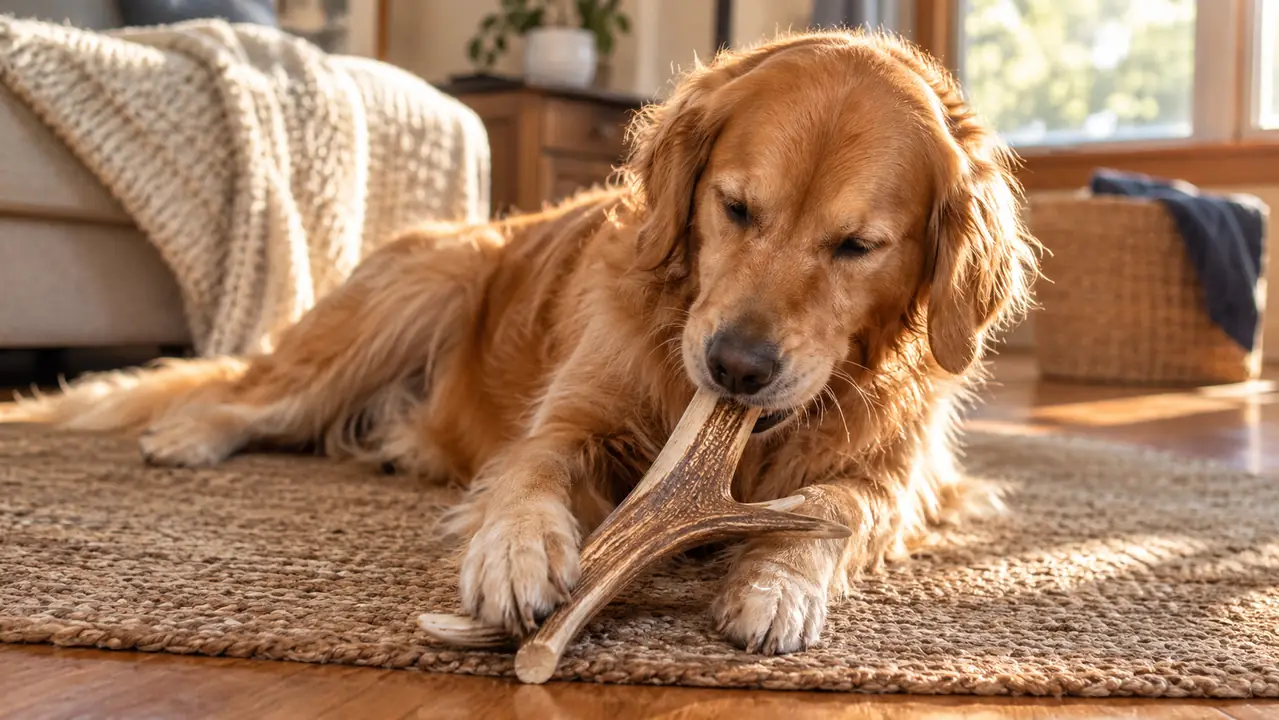
Tucker is seven years old, about 68 pounds, and chews like the rent is due. I have handed him chews that came out of the bag promising to be tough and watched him turn one into gravel before I finished my coffee. He also has a sensitive stomach, which means anything he swallows has to earn its place twice: it has to last long enough to be worth what I paid for it, and it has to agree with him the next morning. That combination is a lot harder to shop for than it sounds, and I have the half-chewed failures in a bin in the garage to prove it.
Which is how I ended up standing in a feed store parking lot turning an elk antler over in my hands and wondering whether I had lost my mind. Eight months ago I bought the Elkhorn Premium Chews X-Large Whole elk antler, the 7 to 10 inch piece, and it is still a chew. Not a nub. Not a shard I found with my bare foot on the rug at eleven at night. Still a chew, and it lives in the toy basket by the back door. What follows is how I introduced it, in the order I actually did it, because a hard chew handed over with no plan is how you end up with a cracked tooth or a dog who loses interest in ten minutes and never picks the thing up again.
The one chew that has outlasted eight months of a 68-pound dog
X-Large whole and un-split, 7 to 10 inches long with a 1.25 to 2.0 inch diameter, sized for dogs in the 50 to 90 pound range. Hand-cut and smoothed to take off sharp edges before it ships.
Amazon Check Today's Price on Amazon →How to Introduce an Elk Antler, Step by Step
Step 1: Size It for the Dog You Actually Have
Size is the first decision and it is the one people rush. The X-Large whole antler runs 7 to 10 inches long with a 1.25 to 2.0 inch diameter, and it is intended for dogs in the 50 to 90 pound range. Tucker sits at 68 pounds, which puts him square in the middle of that. A dog noticeably under the range cannot get a proper grip on something that thick and will quit out of frustration before it ever gets going. A dog well over it will work through the piece faster than you would like, and you will be replacing it sooner than you planned.
Whole versus split matters just as much, and this is the part I would tell a friend about first. A split antler has the marrow exposed, which hands a dog an easy place to start. That sounds generous until you watch a heavy chewer go straight at that exposed middle. The Elkhorn piece I bought is whole on purpose, and the reason is simple math. Whole means he has to work the outside of it. It takes him longer to get started, and it lasts a good deal longer once he does.
Expect variation when the box shows up. This is a natural product, hand-cut piece by piece, so the antler that arrives may run fatter or more slender than the picture on the listing. That is normal and it is not a defect. What you are checking for when you open it is whether the piece is big enough that your dog has to work at it from the side, rather than being able to take it straight back into his molars like a stick of gum.
Step 2: Pick the Right Fifteen Minutes
Timing does more work than people give it credit for. Hand a new chew to a dog who is already worked up from a walk, or who is watching you fill his bowl, and he will either ignore it completely or try to swallow his way through it. I give Tucker a new chew after a meal, when he has already eaten and is settling onto the rug anyway. He is calm, he is not hungry, and chewing is what he already wants to do with the next twenty minutes.
Pick your spot with the same care. I do the first session on the rug in the living room or out on the back porch, never on the couch and never on carpet I care about. A hard chew gets dropped, and a hard chew rolls. Fifteen minutes is plenty for the first go, and I take it away while he still wants it. A session that ends with him bored is a session he will not be eager to repeat tomorrow.
The first time, expect him to be unsure. Tucker sniffed his for a good two minutes, gave me a look like I had handed him a rock, and then wandered off. I put it up and brought it back the next evening and he went at it like it was his idea. Do not stand over him tapping your foot. Leave the piece down for a short stretch, pick it up, try again the next day. It is a new object with an unfamiliar smell, and most dogs come around on their own schedule.
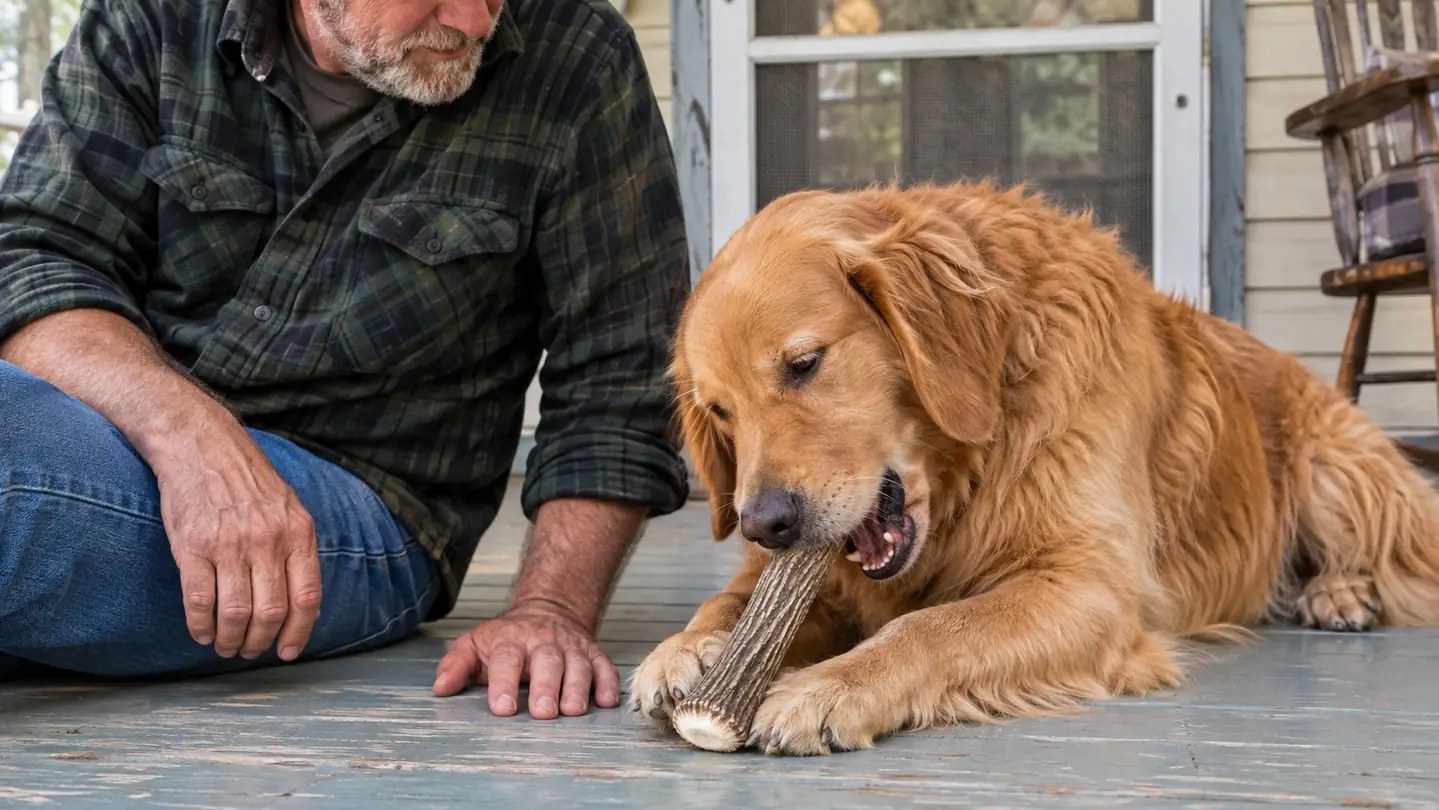
Step 3: Sit on the Floor and Actually Watch
For the first few sessions I sit on the floor with him. Not on the couch reading, not in the kitchen with my back turned. On the floor. You learn a surprising amount in ten minutes. Some dogs gnaw at the end of a chew like a beaver working a sapling. Some try to hold the piece between their paws and crack it with their back molars. Tucker is the second kind. Knowing that is the entire reason I check his antler every week instead of every month.
Have a trade in your pocket before you start. I keep a few of the soft training treats in a pouch on my belt, and I use one to swap for the chew when the session is over. Trade, do not wrestle. If you pry it out of his mouth every single time, he learns that the chew is a thing worth guarding. If you trade, he learns that giving it up gets him something and that the chew comes back later. That one habit has saved me more grief than any chew I have ever bought.
Know what normal looks like on a hard natural chew. A little pink on the antler during the first few sessions is normal. A dog who yelps, paws at his mouth, or loses interest in his food is done for the day and probably done with that piece for a while. I am not a vet and I do not play one on the porch. If something about his mouth worries you, put the chew up and make the call.
Eight months of a 68-pound dog, and the only reason that antler is coming out of the basket is because I decide to retire it. Not because he finished it.
Step 4: Put It on a Rotation and Keep It Out of Sight
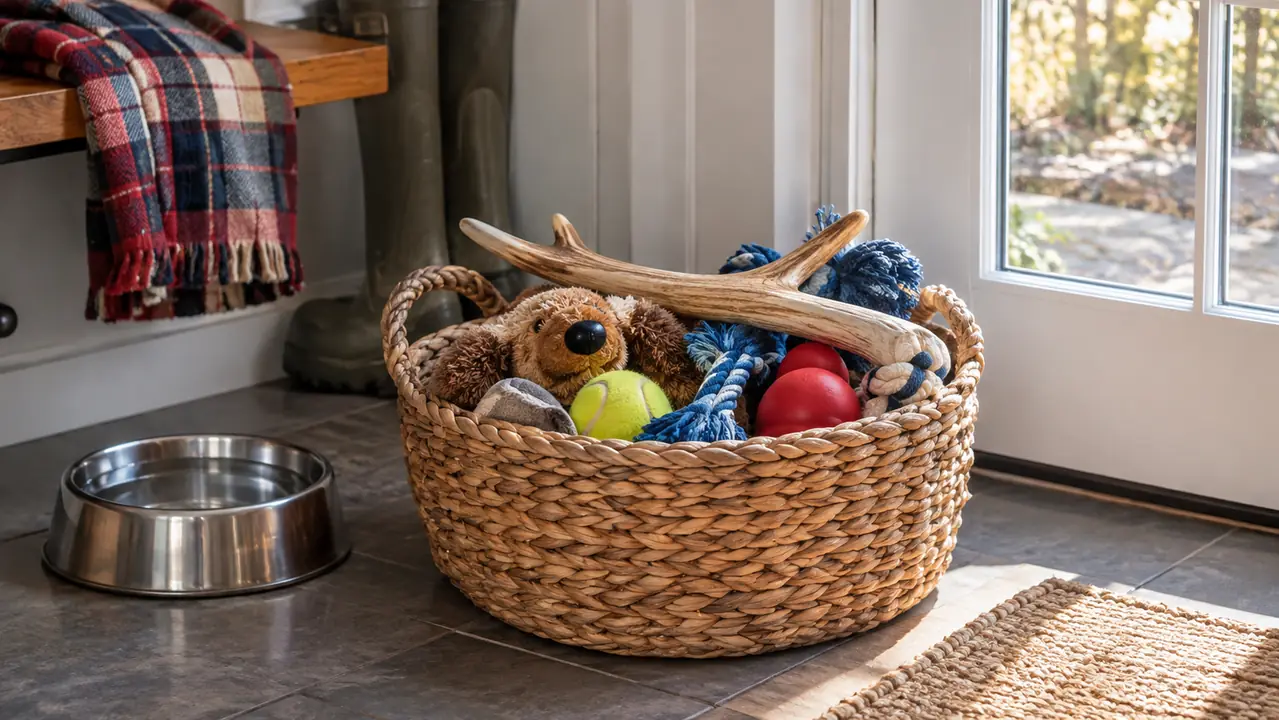
The Elkhorn antler lives in the toy basket by the back door. It does not live on the living room floor. That is deliberate. A chew that is always available becomes furniture, and dogs walk right past furniture. A chew that comes out two or three times a week, mostly when I am out in the garage or working in the yard, stays interesting. Keeping it put away also means I always know where it is when I want to look the piece over, which matters more than it sounds.
The rotation matters for a second reason. A hard antler is a long, slow project, not a fifteen-minute event. A bully stick is gone in forty-five minutes to an hour around here. The yak cheese takes him several days of twenty to thirty minute sessions. The antler is measured in months. Having all three in the basket means he gets a fast win some days and a long slow one on others, and nothing in the rotation goes stale.
One rule I do not bend: the antler is a supervised chew. It comes out when I am around and it goes back in the basket when I go inside for the night. A hard chew left down on the floor overnight is a hard chew nobody is watching, and I would rather be the guy who is slightly annoying about it than the guy making a drive to the emergency clinic at midnight.
Step 5: Check It Every Week and Retire It on Your Schedule
Once a week I pick the antler up and run my thumbnail along the edges and around both ends. Elkhorn Premium Chews hand-cuts and then smooths each piece to remove sharp edges before it ships, and mine arrived smooth. But teeth carve new edges over time. Eight months of chewing has changed the surface of Tucker's piece noticeably. A quick pass with a nail file or a scrap of sandpaper handles the small stuff before it becomes a problem.
The retirement rule is simple and it is mine to make. When the piece gets small enough that he can get all of it into his back teeth, or short enough that I could imagine him getting it down whole, it goes in the trash. I would rather throw away an antler with some life left in it than find out the hard way that I should have. With a whole X-Large and a 68-pound dog, we have not come close to that yet.
If he goes off it for a while, that is fine too. I have put the antler up for two or three weeks at a stretch and then brought it back out to a dog who acted like it was a brand new thing he had never seen. Chews do not spoil in a basket. The interest comes back on its own.
What Else Helps
A chew is not a meal and it is not a treat, and keeping those three categories straight makes the rest of this easier. Tucker gets his antler on the porch or on the living room rug with me nearby, and there is always water down. The soft training treats are for recall and leash manners on walks and at the campground, broken into small pieces, because those are rewards and not something to lie around working at for an hour.
Storage is worth thirty seconds of thought. The antler lives in the toy basket by the back door. The bully sticks live in a sealed jar on the kitchen counter, a habit I picked up after a batch of cheaper ones made the whole house smell like a bait shop. The yak cheese stays in the pantry in its original bag. The dental treats are in the cabinet above the dog food bin, one a day after supper. None of it is complicated, but having a place for each thing means nothing gets lost under the couch for a month.
Keep your vet in the loop on teeth. Chewing does real work on tartar and I do think it helps. It is not a replacement for a cleaning or for brushing. Tucker still goes in for his regular checkups and still has his teeth looked at while he is there. The antler is part of the routine, not a substitute for it, and any vet will tell you the same thing if you ask.
Eight months in, it is still a chew and not a nub on the rug
The Elkhorn X-Large whole antler is un-split, 7 to 10 inches long, intended for dogs 50 to 90 pounds, and hand-cut and smoothed to remove sharp edges. Pick the right size, time the first session, and it lasts.
Amazon Check Today's Price on Amazon →