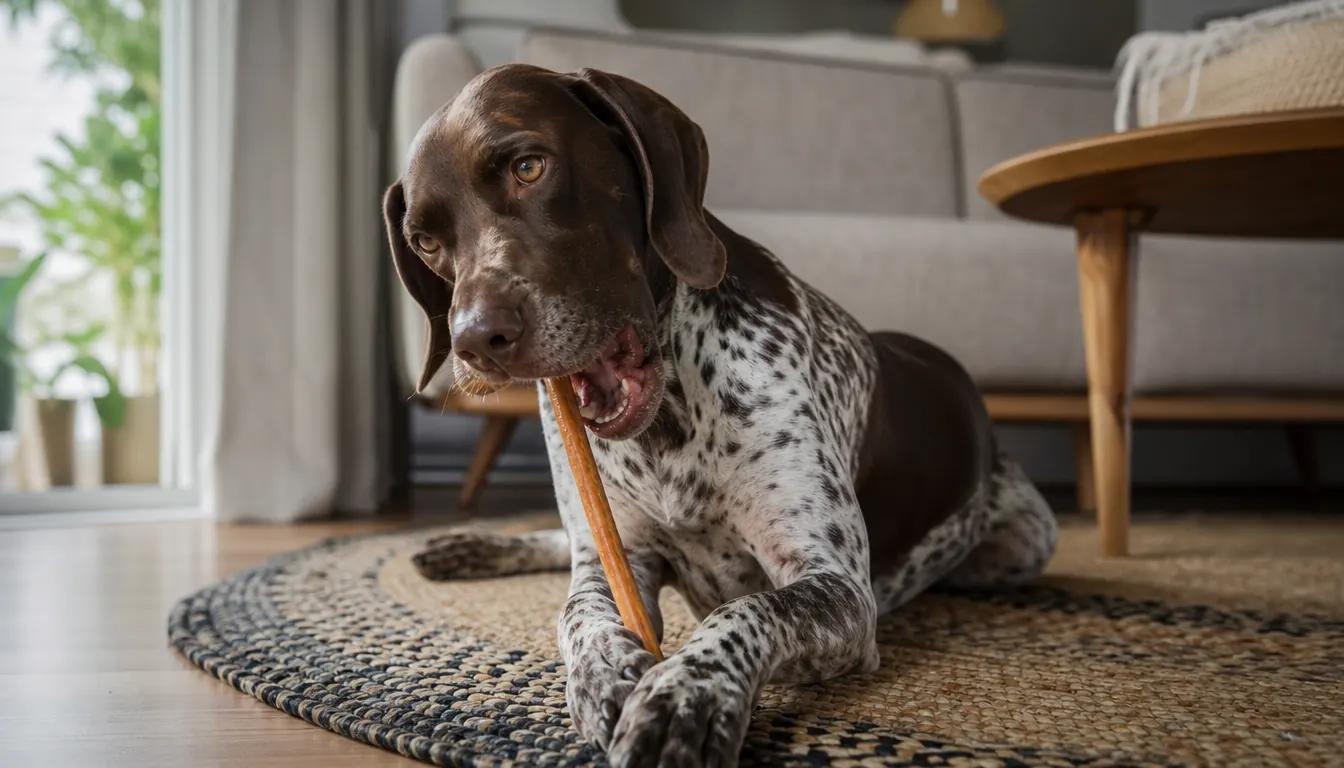
Short answer first, since that is why you clicked: for a big dog with strong jaws, I would buy the Himalayan Dog Chew yak cheese chew first. It lasts for days instead of an afternoon, it does not leave a smell in the room, and it goes in a backpack. But the bully stick is not the loser. It is the better treat, and there is a real difference between a treat and a chew. One is a project your dog works on. The other is something your dog is finished with before you finish your coffee. I keep both, and I will tell you exactly where each one earns its shelf space.
My name is Wes Calloway. I am 54, retired out of HVAC work, and I live outside Murfreesboro, Tennessee, with my wife Darlene and a 7 year old yellow Lab mix named Tucker. He runs about 68 pounds, he chews like the clock is running, and he has a sensitive stomach, which is why every chew in this house gets read before it gets handed over. The Himalayan Dog Chew three pack has been in the rotation about 10 months. The bully sticks I buy are the 12 inch odor-free ones in the 5 count, and those have been around about 14 months. Neither one got quietly thrown out.
| Himalayan Dog Chew Yak Chews | Bully Sticks | |
|---|---|---|
| What it is | A hard cheese stick made from yak and cow milk, smoked and dried | Dried beef, one ingredient, softer than it looks |
| How long one lasts | Several days, in 20 to 30 minute sessions | 45 minutes to an hour, then it is gone |
| Smell indoors | Faint smoked cheese, then nothing | Mild with odor-free brands, strong with cheap ones |
| Dog enthusiasm | Steady, methodical work | Knocks over a chair when the jar opens |
| Ingredient list | Yak and cow milk, no binding agents, preservatives or additives, grain and gluten free | A single ingredient, beef |
| Hardness | Very hard, best for a dog with sound teeth | Softens as the dog works it |
| Food sensitivities | Dairy based, no meat protein | Beef, so a beef-sensitive dog has to skip it |
| Travel and camping | Goes in a pack, no cooler needed | Packable but greasier in a tent |
| Mess | Crumbs on the rug you find later | Greasy marks on fabric and carpet |
| Supervision | Always, like any chew | Always, and take the last two inches |
Where Himalayan Dog Chew Wins
Time is the first win, and it is not close. A bully stick lasts Tucker 45 minutes to an hour. That sounds like a lot until you watch it happen, and then he looks up and the afternoon is still going. A yak cheese stick gets worked in 20 to 30 minute sessions, and it is still a chew on the third or fourth day, which means one stick covers most of a week of evenings on the back porch. For a 68 pound dog who needs a job, that math matters more than any claim on the front of a bag. I started keeping a note on the fridge for a while, just to be sure I was not fooling myself about the difference, and the note said the same thing every week: one stick, four sittings, and a nub left over. Fourteen months of buying bully sticks never produced a note like that.
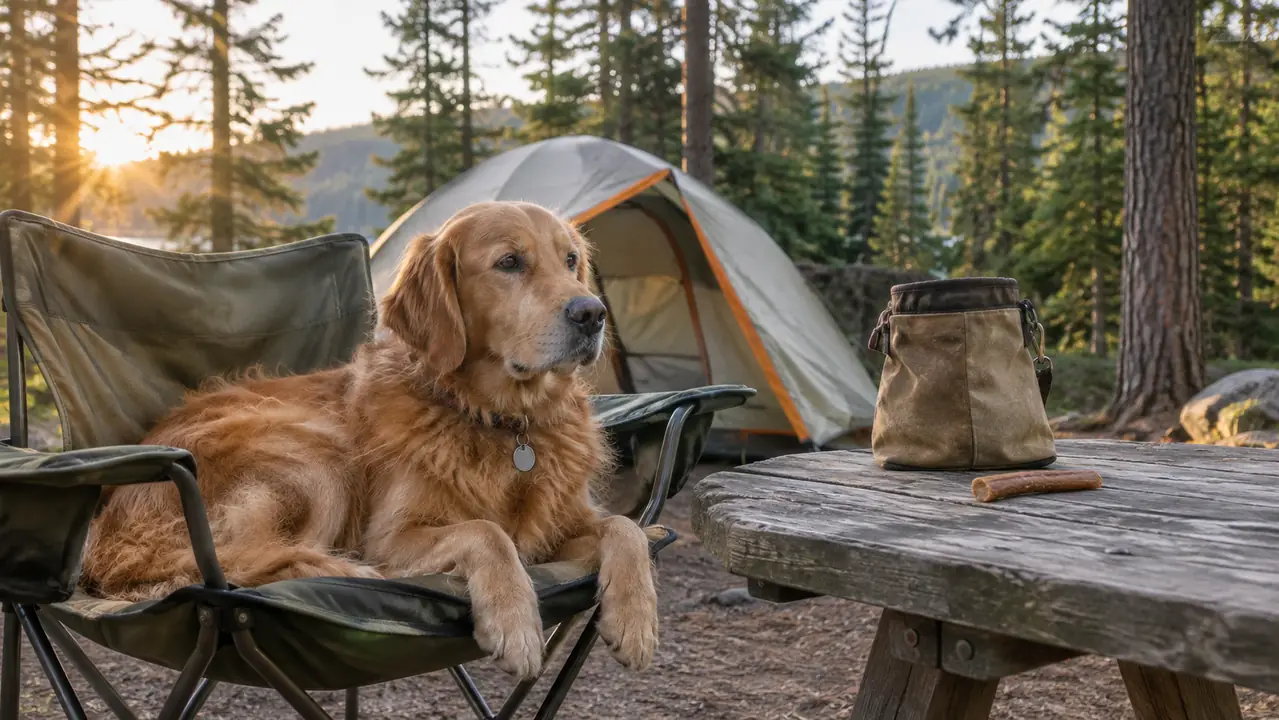
The second win is what it does to the room. Bully sticks have a smell. The odor-free ones are better than the cheap ones, no argument, but better is not the same as none, and my wife can tell from the kitchen when one comes out. The Himalayan Dog Chew sticks smell like a mild smoked cheese and then they stop. That is the whole reason the yak chew is the one that goes camping with us at the state park a few weekends a year. It rides in the pack, it does not need a cooler, and it will not grease up a tent floor at nine at night. Last October we drove up on a Friday after I got the truck loaded, and the chew spent the whole weekend in the side pocket of the pack. It came home in the same shape it left in. A bully stick in that same pocket would have been a bag of grease by Saturday noon.
Where Bully Sticks Win
Enthusiasm. That is the honest answer. When I open the jar on the counter, Tucker's ears come up. I do not get that with the cheese chew. He is glad to see it, but he is not going to knock over a chair. If your dog is a picky chewer who walks away from hard textures, a bully stick is what gets him started, and a dog who never chews gets no benefit from a chew at all. I have watched him carry a bully stick to the rug and settle in before I have the lid back on the jar. The cheese chew he takes and then thinks about for a minute, like he is deciding whether this is work or a treat. It is work, and he knows it, and on some nights that is exactly what I want from him.
Two more points in the bully stick column. First, the label. A good bully stick is one ingredient, dried beef, and a label reader cannot argue with that. The Himalayan Dog Chew stick is clean too, yak and cow milk with no binding agents, preservatives or additives, grain free and gluten free, but it is still dairy. If your dog is beef-sensitive, flip this paragraph around. If your dog is dairy-sensitive, the bully stick is the safer bet. Second, hardness. Yak cheese is hard. A senior dog with worn teeth, or a dog with a history of a fractured tooth, is not the dog for this chew. A bully stick gives as the dog works it. That give is why I hand one to a friend's older dog without a second thought, and why I ask about teeth before I hand over a cheese stick.
The Chew That Is Still There on Thursday
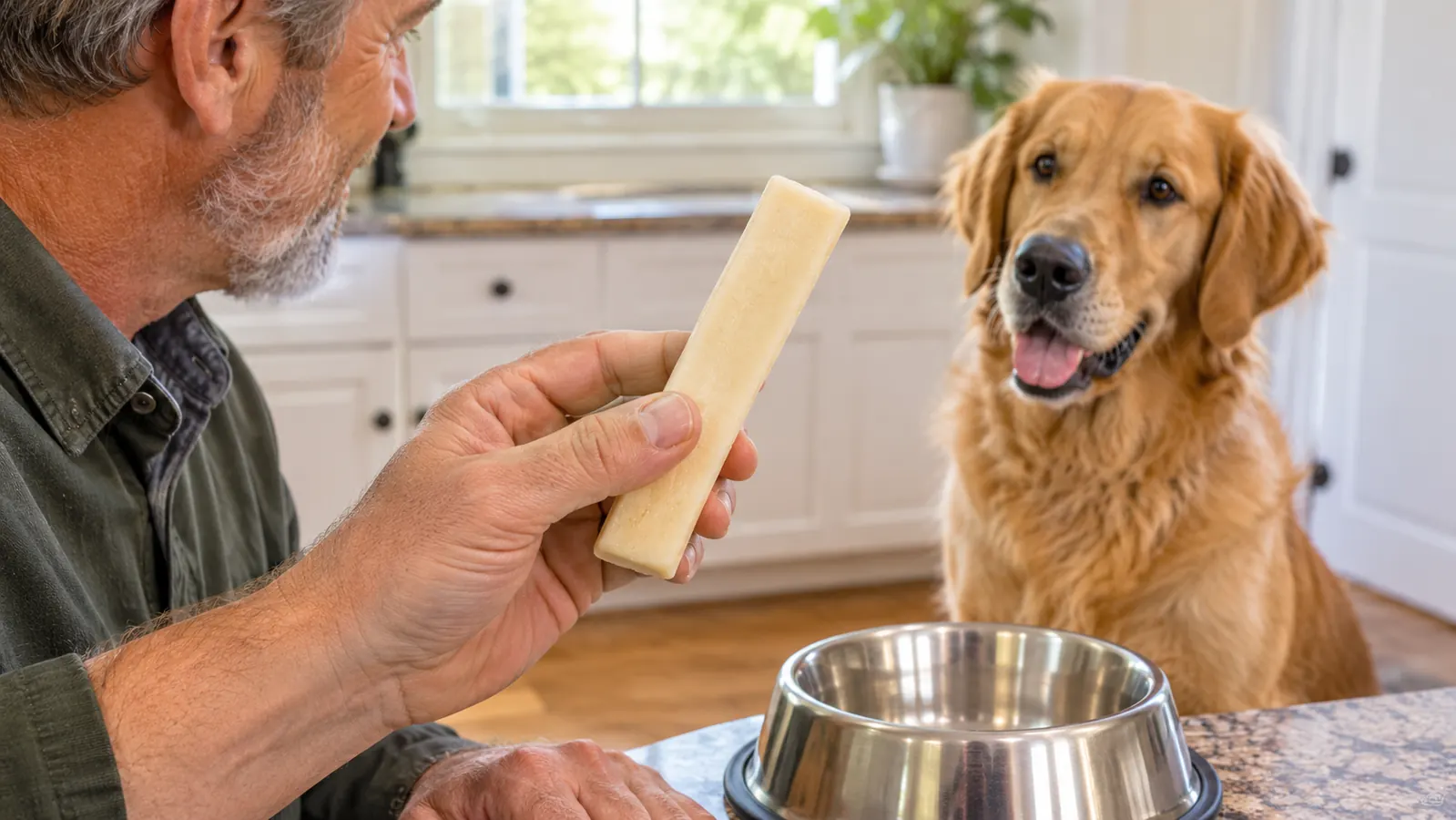
Three Large and Extra Large sticks, about 3.3 ounces each, sized for dogs 65 pounds and up. One stick covers several evenings of work instead of one.
Amazon Check Today's Price on Amazon →What Each One Actually Is
A yak cheese chew is close to what it sounds like. Milk, from yaks and cows, cooked down and smoked and dried until it is hard as a piece of wood. The Himalayan Dog Chew version follows an old recipe from the mountains of Nepal, and the ingredient list is short because it can be. Three sticks, each about 3.3 ounces, sized Large and Extra Large for dogs 65 pounds and up. The bag weighs 9.9 ounces and the sticks run about 5 by 1 by 4 inches. Tucker sits at 68 pounds, the bottom edge of that range, and the size is right for him. I measured one against the palm of my hand the first week, mostly out of curiosity, and it ran from the heel of my hand past my fingertips. That is a serious piece of chewing for a dog his size, and it is why one stick goes the distance.
A bully stick is dried beef. One ingredient, a muscle rather than a bone, and it softens as the dog works it, which is why it does not usually chip a tooth the way a hard nylon or an antler can. It also has a reputation for a certain smell, and that reputation was earned the hard way in my kitchen before I switched to the odor-free ones. Some dogs care about the smell. Mine does not. My nose does. The first bag I ever bought was a store brand, and by the second evening Darlene asked me what had died in the laundry room. That bag finished its life in the garage, and I have bought the odor-free ones ever since.
So you have one chew that is a very hard dairy product and one that is dried meat. That single difference explains every row in the table above.
Ten months in, the Himalayan Dog Chew stick is the only thing in this house that keeps a 68 pound Lab busy for half an hour and then lets him walk away on his own.
How I Use Them, and the Nub Problem
Both get supervised. That part is not negotiable. A bully stick goes in the trash at about two inches, because that last piece is exactly the size that goes down whole, and I stopped feeling bad about it after the first bag. The yak chew ends differently. When Tucker works it down to a small nub, I put it in the microwave for about 45 seconds and it puffs up into a crunchy piece he can finish. Let it cool before you hand it over. That trick is the reason the last inch of a cheese chew never gets wasted. The first time I tried it I gave it to him too warm and he dropped it on the rug and looked at me like I had handed him a hot coal. Give it a minute on the counter. Forty five seconds in the microwave, then a minute of patience.
Storage matters more than people expect. Yak chews live in the pantry in the original bag. Bully sticks live in a sealed jar on the kitchen counter, and that jar is the reason I stopped buying the cheap ones. A cheap bully stick in an open bowl will announce itself to your whole downstairs by Wednesday. Neither chew needs the refrigerator. Neither should ride around in a hot truck. In July I left a bully stick in the console of the truck for a morning by accident, and it came out soft and slick and went straight in the trash. Lesson learned at the cost of one stick.
Ten months in, the cheese chew has held its shape better than I expected. He has never gotten a whole stick down in one sitting, and I have never had one crack apart in a way that worried me. Fourteen months in, the bully sticks are consistent, which is all I ask. One is a chew he owns for a week. The other is a treat he owns for an hour. Both are doing what I bought them to do.
What I Liked
- Lasts several sessions instead of one sitting
- Yak and cow milk only, no binding agents, preservatives or additives
- Grain free, gluten free, and low odor indoors
- Sized Large and Extra Large for dogs 65 pounds and up
- The leftover nub puffs in the microwave, so almost nothing is wasted
Where It Falls Short
- Hard enough that a senior dog or a dog with a worn tooth should skip it
- Dairy based, so not for a dairy-sensitive dog
- Leaves crumbs on the rug that you find in your socks later
- Some dogs lose interest in a hard chew before it is done
Safety Notes I Do Not Skip
A chew is not a babysitter. I stay in the room, I take the last piece, and I check the hard chews for sharp edges before they go back in the bag. Fresh water stays down the whole time a chew is out. The hardness question is real, and I ask my vet at the yearly visit whether Tucker's teeth can still handle a hard chew. The day that answer changes, the cheese chews stop. I would rather buy a different chew than pay for a dental. The check itself takes ten seconds. I run my thumb along the edge, and if it catches, that stick is done. Ten seconds against a vet bill is not a hard trade.
If your dog has a sensitive stomach, introduce a dairy chew slowly. Mine does, so the first session was a short one and I watched him afterward. Nothing dramatic happened, and I still would rather find that out over an evening at home than two miles out on a trail.
What I Tried Before These Two
Before either of these, there was rawhide, and there was a bag of cheap bully sticks from a big box store that smelled so bad I moved them to the garage. The rawhide went out after I read enough about how it is processed to lose my appetite for it. The cheap bully sticks went out because a chew that has to live in the garage is not a chew, it is a chore.
The antler in the toy basket came after those, about 8 months ago, and it is a different category entirely. It is what comes out when I am working in the garage or out in the yard, because it lasts and lasts and he cannot finish it. But it is hard, and it is not what I hand him on the living room rug after supper. The cheese chew and the bully stick are the two that fit that slot.
Who Should Buy Which
Buy the Himalayan Dog Chew three pack if you have a heavy chewer with sound teeth, if the smell of a bully stick bothers somebody in the house, if the chew needs to travel, or if your dog cannot do beef. Buy bully sticks if your dog is picky and needs a high-value reward to get started, if your dog is older with worn teeth, or if you want a single-ingredient meat chew and nothing else.
The group in the middle is the biggest group. That is a dog who chews hard, has decent teeth, and lives indoors with people who have noses. If that is your house, the cheese chew is the everyday buy and the bully stick is the occasional one. That is the arrangement here, and it has held for over a year without either bag going stale in the back of a cabinet.
One last thing, and it is the thing I would tell a friend. Buy the size that matches your dog's weight, not the size that looks impressive. A stick that is too big for the mouth gets dropped and forgotten, and a stick that is too small disappears in one sitting. Tucker sits at 68 pounds and the Large and Extra Large sticks are the right fit for him.
One Bag, Three Sticks, a Week of Evenings
Large and Extra Large, about 3.3 ounces each, for dogs 65 pounds and up. If your dog is a hard chewer with good teeth, this is the one I would start with.
Amazon Check Today's Price on Amazon →