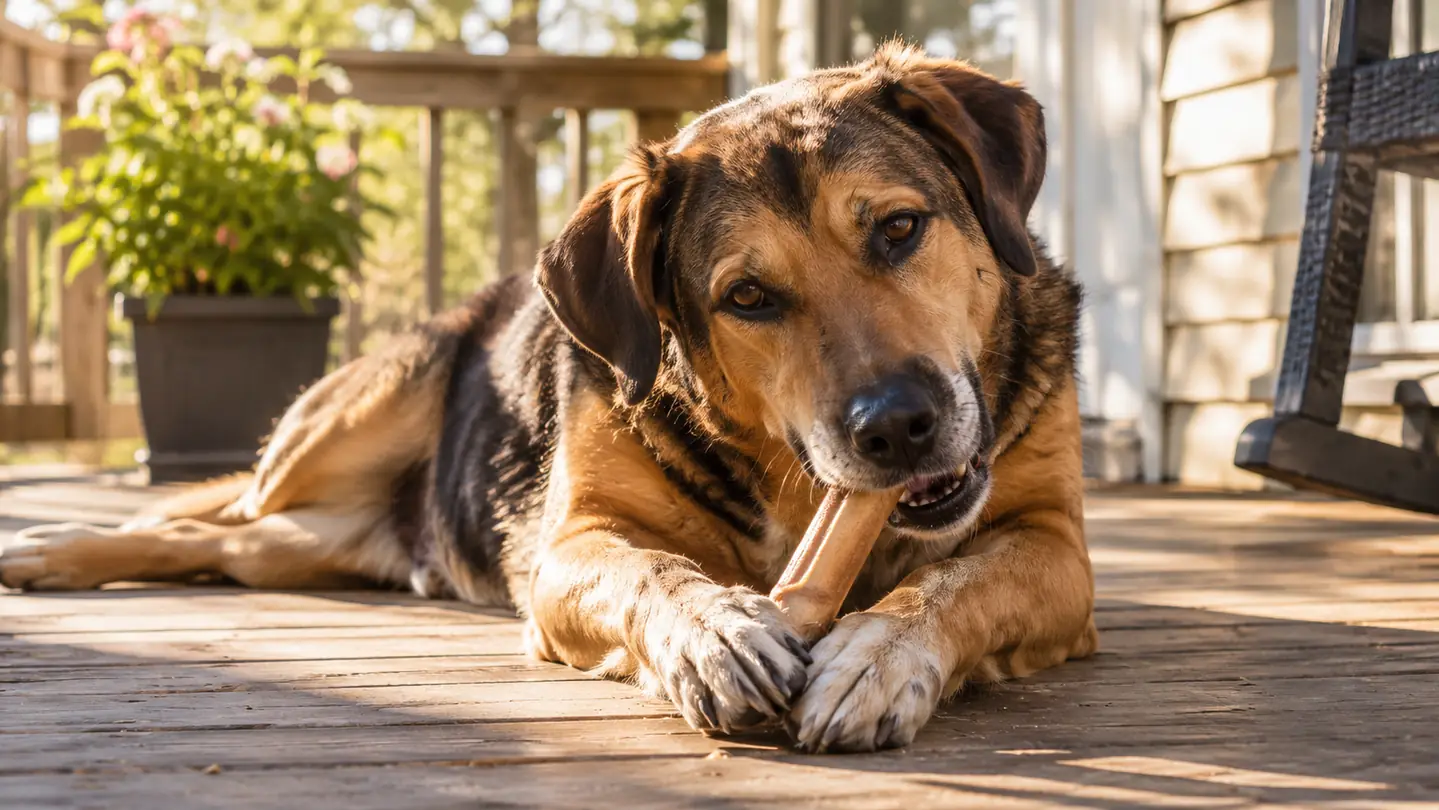
Tucker is seven years old, sixty-eight pounds, and a yellow Labrador mix with the jaw of a bench vise. He took apart a fire hose toy in under an hour. He gnawed the corner off a plastic storage bin. So when I say I have opinions about bully sticks, understand that every one of them was earned on my back porch, with a stopwatch running and a dog staring at my hand.
For a couple of years I bought whatever twelve inch sticks were cheapest at the feed store. The house smelled like a barnyard for two days after he finished one. Worse, a batch splintered into shards near the end, and I spent a Saturday afternoon on my knees pulling pieces out of the rug while Tucker watched me like I was the problem. That was the end of bargain sticks. I switched to Natural Farm Odor-Free Bully Sticks, twelve inch, five to a bag, about fourteen months ago, and I have not shopped around since.
What follows is the checklist I actually run now before any chew goes into the jar on the kitchen counter. Five steps, none of them complicated. If you have a dog that destroys things, you already know the cheap route costs more in the end.
Fair warning: this is not a piece about which brand has the fanciest bag. It is about the five things that decide whether a chew lasts an hour or ten minutes, and whether your dog spends the evening comfortable or hunched over in the yard.
The bag that ended my bargain hunting
Twelve inches, five to a bag, one word on the ingredient line. This is the one that sits in the jar on my kitchen counter.
Amazon Check Today's Price on Amazon →Five Steps I Run Before a Chew Goes in the Jar
Step 1: Read the Ingredient Line Before You Look at Anything Else
Most bully stick bags have a paragraph where a list should be. Stabilizers. Flavoring. Something to keep the color even from bag to bag. I have a dog with a sensitive stomach, which means I stand in the aisle with my reading glasses on and read the back of every bag before anything goes in the cart.
The Natural Farm bag is short. The ingredient line is beef. Their listing says that beef is grass-fed and non-GMO, that it is cleaned with pure water, and that nothing else goes in. That matters more than it sounds like it matters. A chew sits in a dog's mouth for the better part of an hour. Whatever is on it ends up in him, and a dog with a touchy stomach will tell you about it at two in the morning.
My rule now is simple. If the label needs a paragraph, put the bag back. If it needs a chart, definitely put it back. One ingredient is the standard I hold every chew to, and it is the reason the discount bin sticks stay in the discount bin even when they are right there at eye level and cheaper.
Step 2: Match the Length to the Dog, Not to the Picture on the Bag
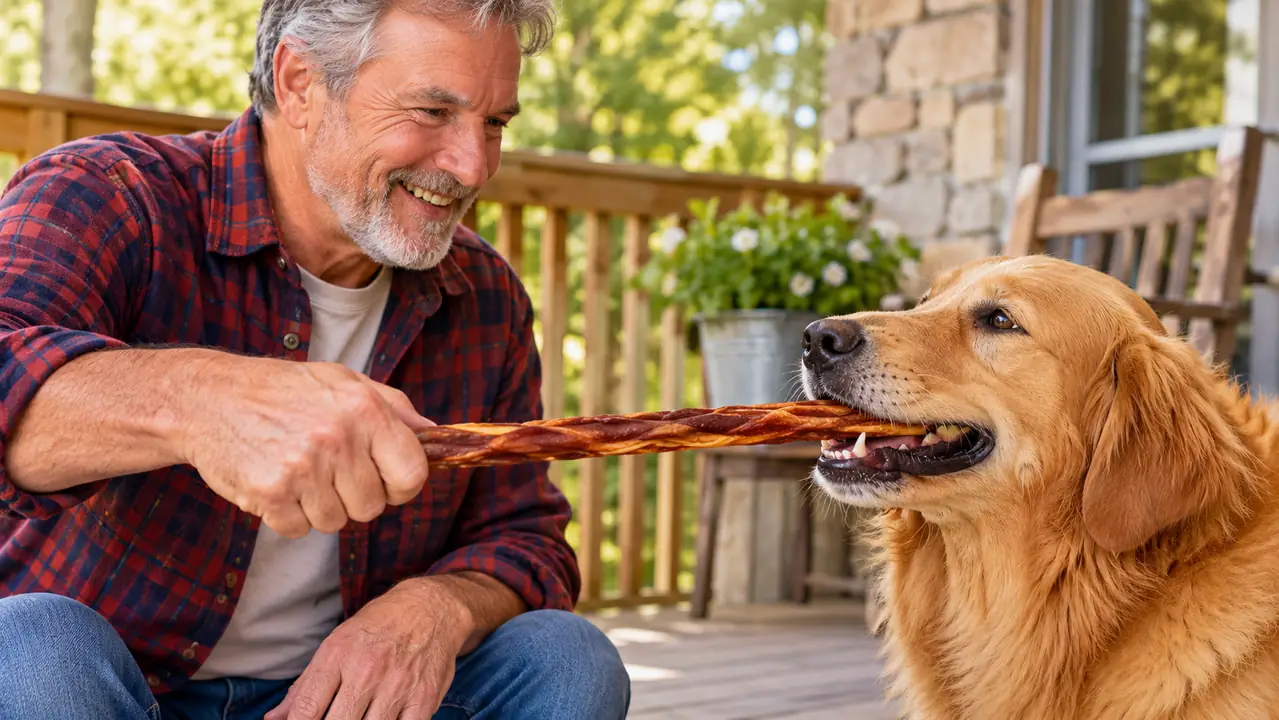
You want a chew long enough that the dog is never working near his back teeth with his whole mouth around it, and short enough that he can actually get somewhere with it. For a sixty-eight pound dog, twelve inches is the number that works in this house. He holds one end, works the other, and there is still three or four inches of margin between his jaw and the far end.
The other half of sizing is knowing when to take it away. I pull the stick at about two inches, every single time. Two inches is small enough that a determined dog can get the whole thing into the back of his mouth, and that is the moment chew time stops being a good idea. The bag gives me five sticks and every one of them ends the same way, with me taking a stub out of his mouth and dropping it in the trash.
Where people get this wrong is buying the giant stick for a small dog because it looks like more for the money, or the short stick for a big dog because it is easier to hold. Size the chew to the mouth that will be working on it.
That habit is worth more than any feature printed on a bag. Long chew, short leash on when it ends. You will not find that on a label, but it is the thing that keeps a heavy chewer out of trouble.
Step 3: Test It Before the Dog Does
Smell it first. Bully sticks have a reputation, and for plenty of brands the reputation is deserved. The first thing I noticed with the Natural Farm sticks is that I can hand one to Tucker in the living room and Darlene does not get up to open a window. In a house with a sealed jar of chews sitting on the counter, that is not a small thing.
Then flex it. Hold a stick at both ends and bend. A good one has some give, like a thick piece of jerky that dried hard. If it snaps with a dry crack and a puff of dust, that is the batch that ends up as shards in your rug. I have had that happen with cheap sticks. I have not had it happen with these.
Check the ends while you are at it. If they are already ragged and splitting before the dog has touched it, that is how the middle is going to look in twenty minutes.
And do this away from the dog. Once he sees a stick in your hand, you are not inspecting anything, you are holding up the mail while he waits.
Step 4: Set the Rules and Keep Them Boring
Tucker gets a stick two or three times a week. Not more. A dog can put away a lot of protein and fat in a short window if you let him, and I would rather he stay regular than be happy for twenty minutes and sick at two in the morning.
He gets it on the back porch if the weather is decent, on the living room rug if it is not. Supervised is not a suggestion printed on the bag, it is the whole arrangement. I am in the room. Not in the yard, not in the garage, not on the phone in the other room. The one time I broke that rule I came back to find him working the last four inches from the side, and I got to reach into a Labrador's mouth and fish it out. That was my fault, not his.
I also keep chew time and meal time apart. He gets a stick an hour or two after breakfast or in the late afternoon, not right before dinner, so I am not filling him up with chew and then wondering why he walks away from his bowl.
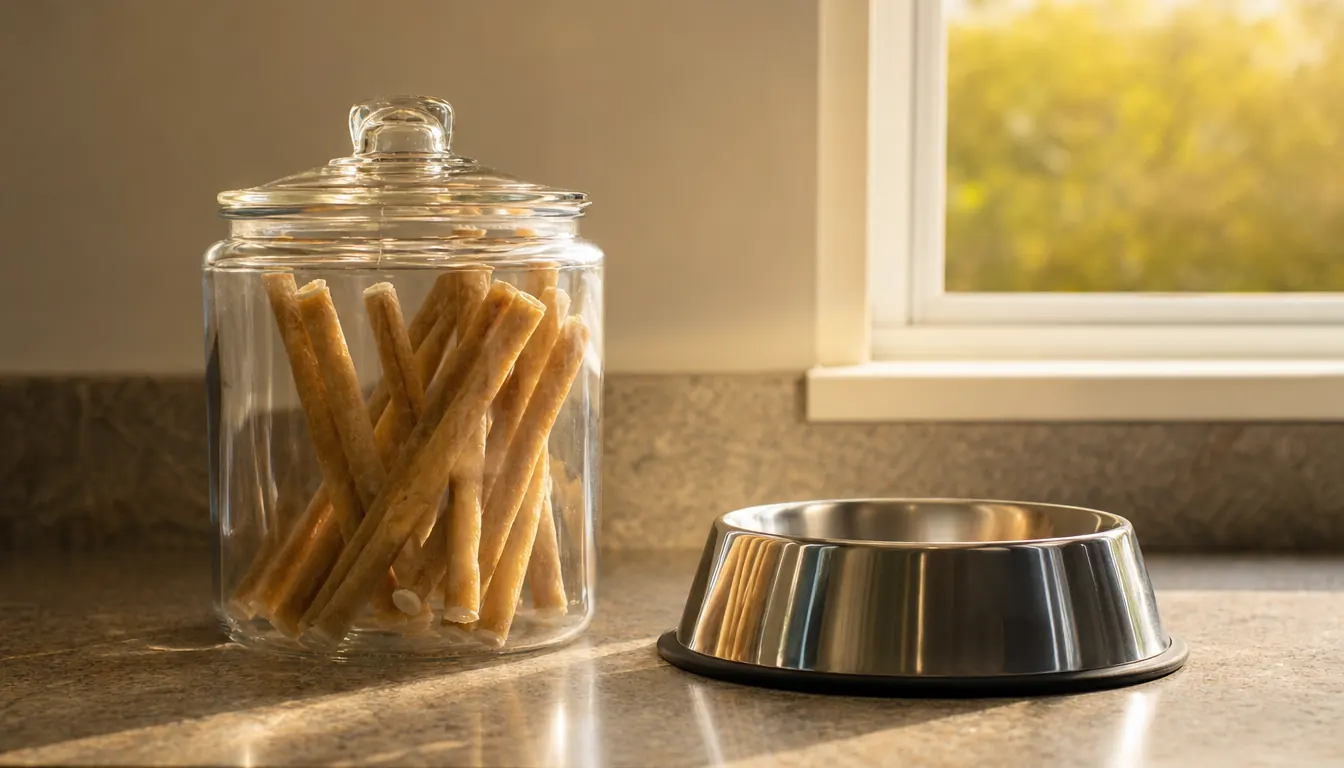
Storage is one place and one place only. The jar on the kitchen counter, lid screwed down. Not the garage where it gets hot. Not a bag in a drawer where it gets forgotten and goes stale. One spot, so I know what I have and when I am running low.
None of this is dramatic. That is the point. The rules that keep a heavy chewer safe are boring rules, and boring is what you want.
Step 5: Do the Math on Minutes, Not Inches
Here is the part that changed how I buy chews. I started timing them. One twelve inch stick keeps Tucker busy for forty-five minutes to an hour. That is not me being generous with the estimate. That is the clock on the stove and a dog who does not quit until I take it away.
Five sticks to a bag means somewhere between three and a half and five hours of chewing per bag. Compare that to the ten minutes a soft treat buys you, or the ninety seconds a cheap stick lasts before it is gone. You are not buying inches. You are buying quiet, occupied minutes, and that number is the one that tells you whether a bag is worth carrying to the counter.
It also tells you when a deal is not a deal. A bag that goes faster is the expensive option no matter what the shelf tag says. I have run that math wrong more times than I care to admit, usually because I was in a hurry and the cheap bag was at eye level.
Timing one bag will tell you more about a chew than any review, mine included. Buy the bag, set a timer on the first stick, and see what you actually got for the week.
Forty-five minutes to an hour per stick, five to a bag, and a dog who still has to be told the session is over. That is the number I buy now.
What Else Helps
A bully stick is not the only thing in my rotation and I would not want it to be. A yak cheese chew has been in the mix for about ten months. Tucker works on one over several days, twenty to thirty minutes at a sitting, and it comes camping because it travels better than a bag of sticks. When the last small nub is left, I microwave it for about forty-five seconds so it puffs up, then hand it back.
There is a whole elk antler in the toy basket by the back door, going on eight months now. It comes out when I am working in the garage or the yard and want him occupied where I can see him. I picked a whole antler instead of a split one because a dog this size goes through a split antler too fast, and I check it once a week for sharp edges.
After supper he gets one Greenies Large dental treat. That is a habit, not a replacement for the vet, who still does cleanings and mentioned tartar on the back teeth a while back. A soft training treat rides in a pouch on my belt for walks and recall practice. Those are rewards, not chews, so they do not count toward the chew budget.
What does not help. Rawhide, which I stopped buying years ago. Anything that turns soft and gummy in the dog's mouth instead of wearing down. And any chew small enough to swallow whole, no matter how much the dog likes it.
Water helps too. A dog working on a dry chew for an hour wants a bowl he can get to. I keep one on the porch and one in the kitchen, and I top both off before I hand over a stick.
The other thing that helps is a vet who knows your dog. Mine has seen Tucker since he was a pup, knows his weight and his teeth, and I run new chews past him before they become a habit. That is worth more than any review, including this one.
None of this is complicated. Read the label, size the chew to the dog, smell it before he does, keep it supervised, and count minutes instead of inches. Do those five things and the bag you carry home is the bag you meant to buy. That is about all I have learned in fourteen months of watching a Labrador work through a stick, and it is the reason the Natural Farm bag keeps ending up on my counter.
If you are going to buy one bag, buy the one you can time
Supervise it, pull it at two inches, keep it in a jar with a lid, and put a stopwatch on the first stick. That will tell you more than I can.
Amazon See the current price on Amazon →