Fourteen months ago I bought a bag of Natural Farm Odor-Free Bully Sticks, the twelve inch size, five to a bag, for one reason. The cheaper sticks I had been buying turned my living room into a smell I could not get out of the rug, and they split into pieces sharp enough that I stopped enjoying watching him chew. My dog Tucker is a sixty-eight pound yellow Lab mix with a heavy jaw and a sensitive stomach. He is also the reason I read the back of every bag in the treat aisle, twice, and put half of them back on the shelf.
Here is the short version before the long one. The sticks last a real amount of time, the smell is close to gone, and the ingredient list is about as short as a label gets. The catch is that this is still a chew made from an animal part, and there are several things nobody prints on the front of the bag that you ought to know before you spend the money. That is what this review is for.
The Quick Verdict
Worth it if your dog is a serious chewer and your house has smelled like a barnyard for a year. Not worth it if your dog bolts his food and would try to swallow the last three inches whole.
Amazon Check Today's Price →The chew that bought me an hour of quiet on a Saturday morning
Twelve inches, five to a bag, one line on the ingredient panel. That is the entire pitch, and it held up for fourteen months at my house.
Amazon Check Today's Price on Amazon →How I've Used It
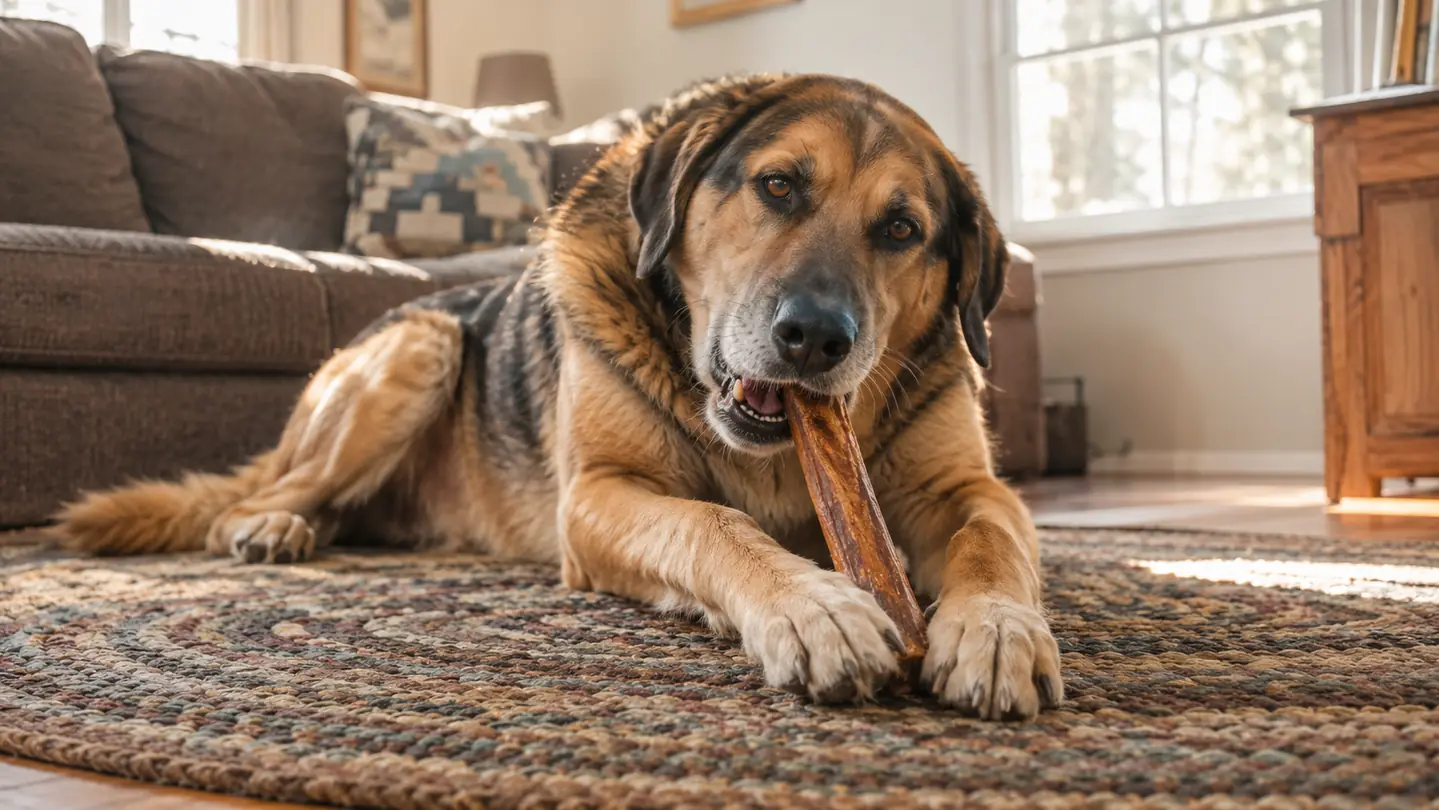
Tucker gets one two or three times a week, always with me in the room, usually on the back porch when the weather is decent and on the living room rug when it is not. I hand it over, he carries it to his spot, and I get somewhere between forty-five minutes and an hour of him being completely occupied. That number is the whole reason I keep buying them. The cheap sticks I used to buy were gone in twelve minutes and left a pile of wet shavings behind that I would find with a bare foot three days later.
I take the stick away when it gets down to about two inches. That is not a rule I invented out of nerves. A two inch stub is exactly the size and shape that can get wedged at the back of a dog's mouth, and I have watched Tucker try to finish one off by tipping his head straight back. I keep a cheap tape measure in the junk drawer by the back door for exactly this, and I have measured more stubs than any grown man should admit to out loud. When the end gets inside that range it goes in the trash and he gives me a look like I have personally betrayed him. He gets over it in about ninety seconds. Ninety seconds of dirty look, then he is at the door asking to go out and check on whatever is happening in the yard.
The bag lives in a sealed jar on the kitchen counter, and that arrangement is more about my wife Darlene than about the dog. She has a nose like a bloodhound and she is the one who finally said enough with the smell. The Natural Farm sticks do not perfume the kitchen the way the last brand did. If you have ever walked into a house where a bully stick is being worked on and had to open a window in January, that is the exact thing this product is selling, and it delivers on it.
What Is Actually in the Bag
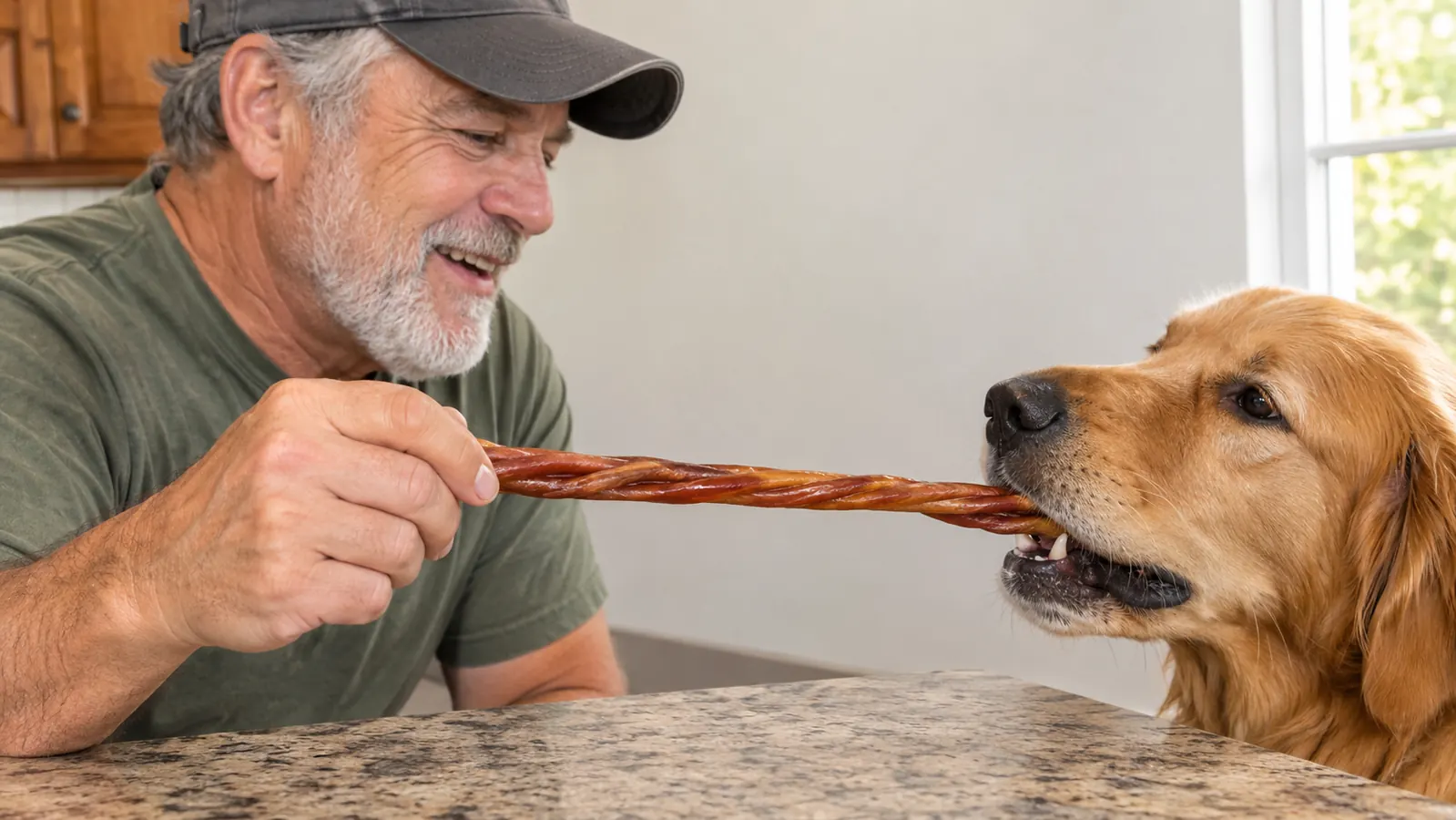
Five sticks. Twelve inches each. The package measures out around 15.75 by 5.12 by 0.8 inches and just over eight ounces for the bag, so these are not the thin pencil sticks that sit in a grocery store bin next to the rawhide. They have some weight to them and you can feel the density when you pick one up. The Natural Farm ingredient panel is short. Grass-fed beef, cleaned with water, and that is the list. The listing says grass-fed and non-GMO, and the company states plainly that nothing else goes in.
I have read enough treat labels to know how rare that is. Most of them start with beef and then wander off into glycerin, cane sugar, and a line that just reads flavoring, which tells you nothing at all about what it is. The ingredients here are beef. That is the whole story. If your dog has a sensitive stomach and you have spent years playing detective with elimination diets, a chew with one line on the label is worth paying attention to.
How Long One Stick Lasts, and Why That Is the Only Number That Matters
Forty-five minutes to an hour. That is the honest figure for a sixty-eight pound dog who chews like it is his job. I have timed it more than once because I wanted to know whether I was buying an hour of quiet or ten minutes and a guilty feeling. Fourteen months in, the number has not really moved. A fresh stick takes longer than one that has been sitting in the jar for a week, because they dry out a little, but the difference is not dramatic. The clearest measurement I have is a Saturday morning last March, when Darlene was at her sister's and I had a stack of paperwork to get through. I set the stick down at 8:40 and looked up at 9:52 with the stub worn down to almost nothing and the paperwork still untouched on the table.
Run the arithmetic and the value question answers itself. A bag lasts us somewhere around a month and a half at two or three a week. Compare that to a bag of soft training treats that disappears in a week, or to a rawhide that gets inhaled in fifteen minutes and then sits in a dog's stomach like a brick. The chew that takes an hour is doing a different job than the treat that takes four seconds, and I would rather buy one thing that works than three things that do not.
Forty-five minutes to an hour of chewing, two or three times a week, for fourteen months, and I have never once had to fish a splinter out of his mouth.
The Smell Claim, Tested
Odor-free is a bold thing to print on a bag and I want to be fair about what it means. It is not zero odor. If you hold one of these up close and sniff, you will know exactly what you are holding. What it does not do is fill a room. The old sticks would announce themselves from the hallway within ten minutes of Tucker starting on one. These do not. If he chews on the rug, the rug does not smell afterward. I ran a crude version of that test the first week the bag was new. Stick on the rug, windows shut, then walk in from the garage an hour later. With the old brand I could tell from the mudroom. With these I could not tell until I was in the same room and looking at him.
The other half of the smell story is the dog's breath, and nobody warns you about that part. Any bully stick leaves a certain something on the breath for a while afterward. It fades. A long drink of water helps. Darlene has opinions about this and none of them are suitable for print.
What Nobody Tells You Before You Buy
First, these are not indestructible and they are not supposed to be. A determined chewer will wear one down, and the last two inches are the part that matters. If you are not willing to sit in the same room and take the stub away, this is not the right product for you, no matter whose name is on the bag.
Second, twelve inches is long. If you have a small dog or a dog with a narrow muzzle, that length is awkward for both of you, and a shorter stick would be easier on everyone. The listing puts the breed size at small to medium and I would take that line seriously rather than reading it as a claim about every dog alive. My sixty-eight pound dog handles the twelve inch without trouble. When the first bag came in I held a stick up against Tucker's muzzle just to see how it lined up, and the thing ran from his nose to somewhere behind his ears. He looked ridiculous carrying it and he did not care a bit. I would not hand one to a ten pound terrier.
Third, this is a chew and not a food. It does not replace a meal, it does not fix tartar on its own, and I still brush Tucker's teeth and still pay for cleanings. The listing mentions dental care and calming among the uses, and chewing does help with both. It is not dentistry. Nobody at my vet's office has ever suggested that a chew could stand in for a cleaning, and I would be suspicious of anyone who did.
Fourth, and this is the one that surprised me, they leave a mark. Not on the rug and not badly, but the fur around Tucker's muzzle picks up a tint on the days he really goes at one, and it takes a washcloth to clear. If you have a pale dog and a low tolerance for him looking slightly worse for wear, plan for it. It comes off. It just does not come off by itself.

Where It Falls Short
The honest complaints. They cost more than the bin at the feed store and I say that as somebody who has bought both. The bag is five sticks and not fifteen, so you will be reordering more often than you would like. I keep a running count on the calendar hanging in the kitchen, mostly so I stop guessing, and the pattern settled at a bag every six or seven weeks. That works out to nine bags in fourteen months, which is a number I would rather not add up in front of my wife.
The ends are hard. The first ten minutes with a fresh stick is a serious grinding session and I can hear it from the next room. If your dog has worn teeth or a history of cracked molars, talk to your vet before you hand over anything this dense. I am not a vet and I am not going to pretend to be one on the internet.
And the bag does not reseal worth a hoot once it is open. The zip strip on mine gave up after about two weeks. That is the entire reason the counter jar exists, so it is a small complaint, but it is a real one. My only defense for the reorder rhythm is that you are buying an hour instead of twelve minutes, and that half the cheap ones ended up in the trash anyway because they split before the dog got any real work out of them.
What I Liked
- One ingredient, grass-fed beef, with nothing else on the label
- Forty-five minutes to an hour of chewing per stick for a heavy chewer
- Does not fill the room the way cheaper sticks do
- Twelve inch length gives you something to hold when it is time to take it away
- Held up across fourteen months at two or three a week
Where It Falls Short
- Five to a bag, so you will reorder more often than you want to
- The zip closure on the bag fails early
- The last two inches are a hazard if nobody is supervising
- Hard enough that a dog with worn teeth should be checked first
- Leaves a tint on the fur around the muzzle that needs a washcloth
How It Stacks Up Against the Other Chews in the House
We keep three chews in rotation and they do different jobs, which is worth saying plainly because the internet loves a single winner. The yak cheese chew is the long game. Tucker works on one for twenty to thirty minutes a session and it takes him several days to get through, and when there is nothing left but a small nub I microwave it for about forty-five seconds so it puffs up and he gets a few more minutes out of it. That is the one that goes camping, because it does not need a jar and it does not need a clock.
The bully stick is the short, intense session. Forty-five minutes to an hour, one sitting, done. If I need him occupied while I am doing something in the yard or talking on the phone, the stick is the tool I reach for. The antler is the background chew that lives in the toy basket and comes out when I am in the garage. He has worn it down slowly over eight months of occasional use. None of them replaced the others. What the Natural Farm sticks did was replace the cheap bully sticks, and that is a narrower claim than it sounds, but it is the true one.
Who This Is For
This is for the person with a dog in the fifty to ninety pound range who chews like it is a paid position and who has already thrown out a bag of something cheaper because it splintered or stunk up the house. It is for the household where somebody has declared war on chew odor. It is for the owner who reads labels and is tired of looking up what four different gums are doing in a dog treat. And it is for the person willing to sit on the porch for an hour with the dog instead of handing over a chew and leaving the room.
Who Should Skip It
Skip it if your dog swallows instead of chews. There is no chew on earth that is safe for a dog who does not grind, and a twelve inch stick is not the place to test that theory. Skip it if you have a small dog, or a senior with dental problems, or a dog who has already cracked a tooth on something hard. Skip it if you want a chew you can leave down while you run errands, because that is not what this is and no honest review should tell you otherwise.
And skip it if the cost per chew is going to make you ration them. A bag in the cupboard and a dog who only gets one on his birthday is a worse outcome than a chew that gets worked on for twenty minutes a day all week. Different chews, different jobs. That is the whole point of a rotation.
One ingredient, one hour, one very quiet dog
If your dog is a heavy chewer and your house has smelled like a barnyard for the last year, this is the fix I landed on. Worth checking the current bag size and price before you order, since both move around.
Amazon See Current Price and Bag Size on Amazon →