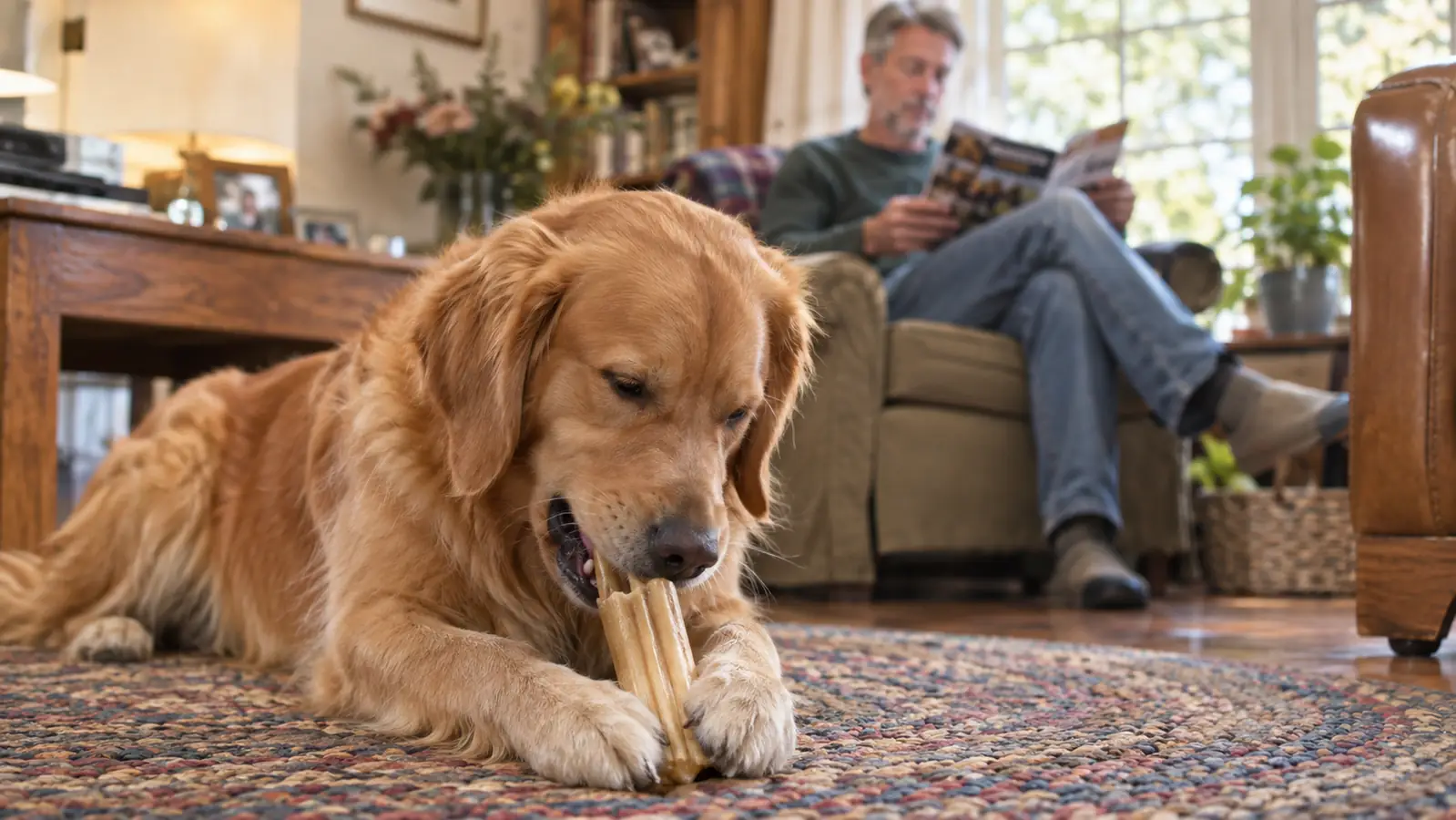
I handed Tucker his first yak cheese chew the way I hand him most things: whole, on the rug, and with the loose assumption that hard means safe. He had it down to a stub inside an evening. A week later I gave him the next one from the same bag with a timer and a plan, and that one lasted him six days. Same chew, same dog. The difference was entirely in the routine, and it took me a couple of sticks to figure that out.
My name is Wes Calloway. Tucker is my 7-year-old yellow Lab mix, about 68 pounds, a heavy chewer with a sensitive stomach, which is the pair of traits that makes every chew decision in this house a small research project. Himalayan Dog Chew yak cheese chews have been in our rotation for about ten months. They live in the pantry in the original bag, and they are the chew that goes camping with us. Below is the five-step routine that has worked, in order, including the parts I got wrong the first time.
The chew that finally slowed my heavy chewer down
Himalayan Dog Chew yak cheese chews come as three large and extra large sticks, 3.3 ounces each, made from yak and cow milk with no preservatives, no binding agents, and no grain or gluten. Three of them is several weeks of sessions for a dog Tucker's size, not one sitting.
Amazon Check today's price on Amazon →Step 1: Match the size to the dog, then leave the bag closed
The Large and Extra Large sticks are the ones sold for dogs 65 pounds and up, which is Tucker almost to the ounce. Each one runs about 3.3 ounces, and the pack measures 5 by 1 by 4 inches, so a single stick is a serious piece of hardware in the mouth of a big dog. That matters more than it sounds like it does. A chew that is too small for a big dog gets worked down to a swallowable chunk faster than you would think, and a chew that is too big gets abandoned after ten minutes because the dog cannot get his back teeth on it. The test I use is simple: can he get his molars on it without pinning it flat and gnawing at the end like a pencil? If yes, it is the right size.
The other half of sizing is being honest about your dog's mouth. These are hard chews. Not flexible, not rubbery, genuinely hard, and they only soften as the dog works saliva into them. I would not give one to a puppy, and I would not give one to an older dog with worn or fractured teeth without asking the vet first. Tucker gets his teeth looked at once a year and I mention what he is chewing, because a hard chew on a bad tooth is a bad trade no matter how much the dog enjoys it.
Before I landed on the Large and Extra Large sticks I bought a smaller size, on the theory that a smaller chew would be the cheaper mistake. It was a mistake, just not the cheap kind. Tucker got one down to a stub in a single evening and came back looking for more, and I spent the whole time hovering over him because the piece left in his mouth was small enough to worry about. Size up, not down. If your dog sits right at the 65 pound line and you are unsure, the bigger stick is the safer of the two, and you can always take it away sooner. Nothing about a chew that disappears in one night is restful for anybody in the room.
Step 2: Make the first one an event, not a handoff
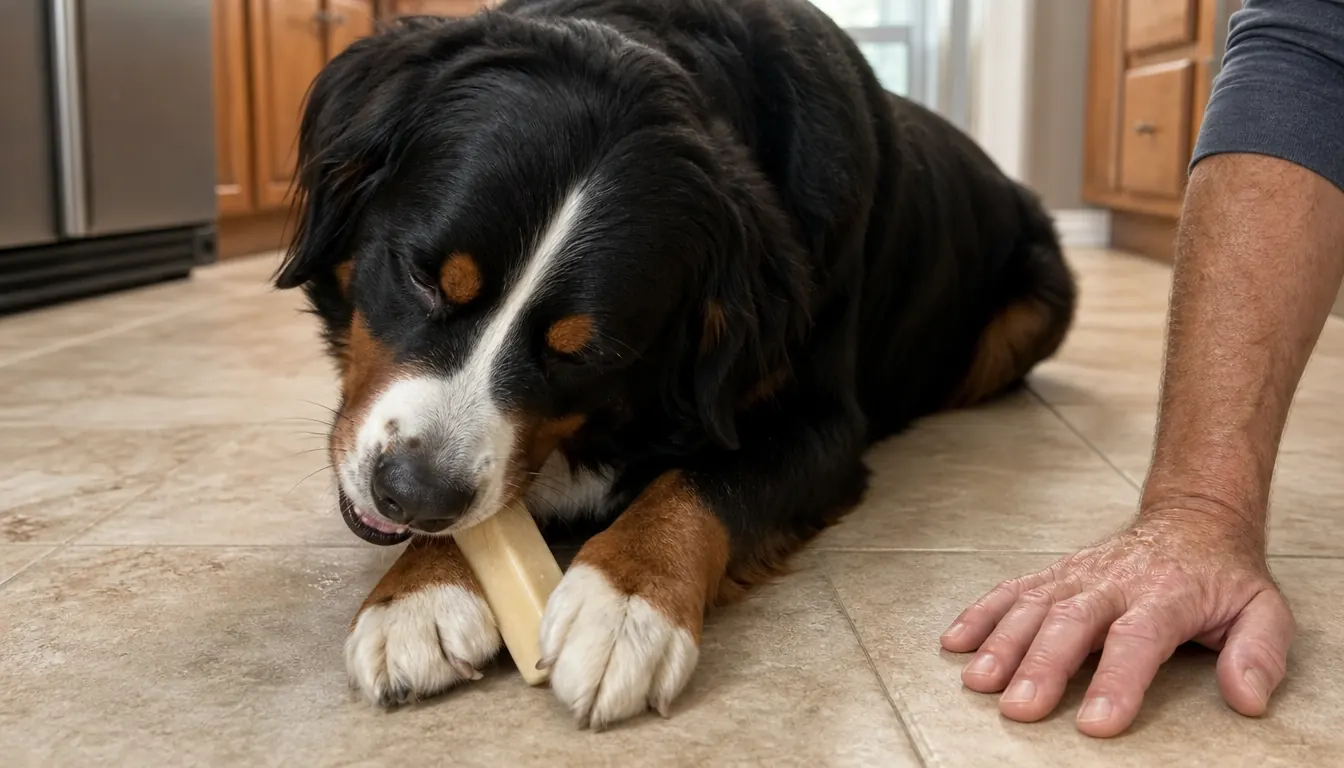
The first one should not be something you toss on the floor on your way out the door. Pick a time when the house is quiet. I do it after Tucker has had his walk and a drink, when he is already winding down, because a dog that is wired up attacks a chew instead of working it. Put it on a rug rather than hardwood. The chew is hard, it clatters, and a rug gives just enough to let the dog brace it. Clear the room of anything you care about, then sit down and watch.
Those first ten minutes tell you what kind of chewer you have. Some dogs grind, working one end down slowly and evenly. Some dogs try to crack it, biting down hard in the middle, and those dogs need a closer eye and shorter sessions. Tucker is a grinder. He holds it between his front paws, licks it, then settles into a slow steady rasp that sounds like someone sanding a table leg. He also drools more with this chew than with a bully stick, so the rug is earning its keep.
The first session I really paid attention to was a rainy Sunday in October. No walk, and by two in the afternoon the dog was bouncing off the walls. I put a stick on the rug, set the timer for twenty-five minutes, and sat on the floor with my back against the couch instead of leaving the room. He worked one end for eleven minutes without looking up. Then he picked it up, carried it to the other side of the room, lay down, and started in on the other end. He still does that. Knowing the pattern means I know where he is going to be and where my bare feet should not be.
Step 3: Set a timer and take it back
Twenty to thirty minutes is one session in this house. When the timer goes, the chew goes up on the counter and out of reach. I started doing that for the obvious reason, which is that a chew in the dog's mouth is a chew I cannot inspect, and I kept doing it for a less obvious one: a dog that gets the chew whenever he wants stops treating it like a project. Tucker works harder at something he has to wait for. Twenty minutes a session, one or two sessions a day, and a single stick stretches over the better part of a week.
Taking it away without a fight is its own small skill. I do not chase him and I do not pry his mouth open. I put a training treat under his nose, he drops the chew to take it, and the chew goes up. Two weeks of that and he started dropping it on his own when I stood up from the chair. If your dog guards chews, this is the step to slow down on, and a trainer is worth the phone call.
The week I got lazy about the timer is the week I learned why it exists. I left a stick on the floor while I went out to the garage for a part, maybe twenty minutes, and came back to a dog who had worked one end into a wedge. Not a disaster. But it was sharper than I like and the session was over early, and I had no idea what he had been doing with it for those twenty minutes. Now picking up and timing are the same habit. The chew comes up when I stand up, whether the timer has gone off or not, and the dog has stopped arguing about it.
Step 4: Retire the nub before the dog does
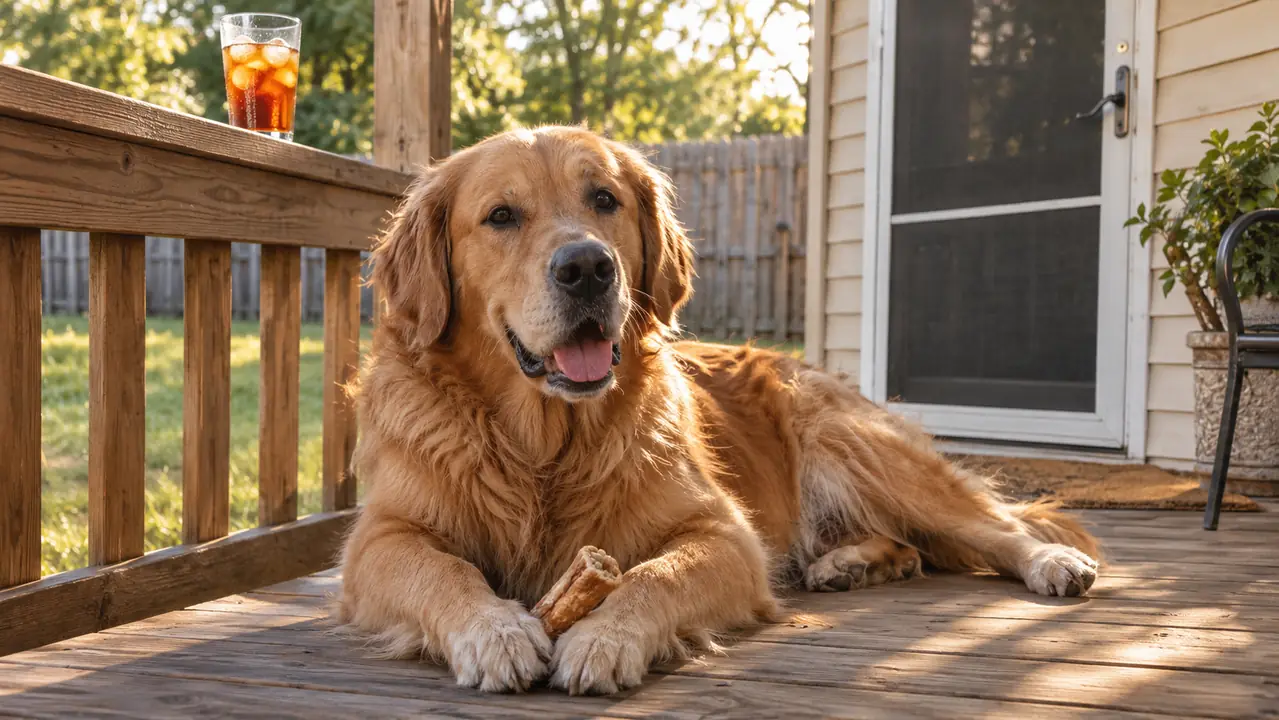
The last two inches are the part that actually worries me. At that size it is small enough to go down whole, and a big dog does not have to try hard to do it. When Tucker gets a stick down to a stub, I take it away and microwave it for about 45 seconds. It puffs up, roughly doubles, and turns into something closer to a cheese puff than a chew. Then I let it sit until it is cool all the way through, because the middle stays hot longer than the outside, and hand it back. He finishes it in a few minutes and it is gone, which is the whole point.
The very last crumb goes in the trash. I know that sounds wasteful. It is not worth the risk, and after ten months of this I can tell you the puffing step is the part people skip and then regret. A minute of microwave time turns a hazard into a snack, and the dog does not know the difference.
Step 5: Store it where the dog cannot reach it, and rotate it
These live in the pantry, in the original bag, on the shelf above the dog food bin. The bag matters. The cheese dries out and cracks if it sits out, and a cracked chew breaks into chunks. This is not a chew that belongs in the toy basket by the back door, which is where the antler lives. The counter jar is for bully sticks. Having three separate storage spots sounds fussy until you realize it is the reason nothing gets eaten by accident while you are at work.
Rotating chews is the other half of it. Bully sticks are the short session, forty-five minutes to an hour and then it is gone. The antler is the long slow one that comes out when I am in the garage. The Himalayan Dog Chew sticks sit in between: a project that lasts days, does not smell, and travels well. They are the ones that go in the truck for camping trips, because a chew that does not leave a smell in a tent is a chew Darlene will allow in a tent.
Camping is where this one earns its place in the rotation. We get out to a state park a few weekends a year, and a dog on a campsite with nothing to do is a dog who finds something to do. Last trip I gave Tucker a session right after we got the tent up, and he settled under the picnic table and stayed there for most of the afternoon while I fought with the firewood. The bag goes back in the truck between sessions, zipped shut, because damp gets into everything at a campground. That is the whole reason I stopped bringing bully sticks on those trips. A chew that has to be kept dry and does not leave grease on a sleeping bag is worth carrying.
What Else Helps
If your dog has a sensitive stomach, as Tucker does, do not hand over a whole chew on day one. This is a milk-based chew, made from yak and cow milk, even though it is grain free, gluten free and free of preservatives and binding agents. Tucker got one twenty-minute session that first day and I watched him the next morning. He was fine. But I have had a chew disagree with him before, and I would rather find that out over twenty minutes than over a whole stick. Start small, and stop if the stool changes.
Keep water down and available. A dog working a hard chew for half an hour drinks more than you expect. I also check his gums after a session, mostly looking for red spots or anything rubbed raw, and I look at how much of the end has worn down. Then I check the chew itself before it goes back in the pantry. If it has developed sharp edges where he has been gnawing, that is what a file is for, or the trash can.
The rule I do not bend is supervision. The chew does not go in the crate, it does not stay on the floor when I leave the house, and it does not get handed over while I am doing something else in another room. Every hard chew carries some risk, and the routine above exists to keep that risk small. A chew is only a good thing if the dog is still fine the next morning.
Tucker got one evening out of the first stick and six days out of the second. The chew did not change. The routine did.
Start with one twenty-minute session, not one whole chew
Three large and extra large sticks, 3.3 ounces each, for dogs 65 pounds and up. Give the first one a rug, a timer and your attention, then watch how your dog works it.
Amazon Check today's price on Amazon →